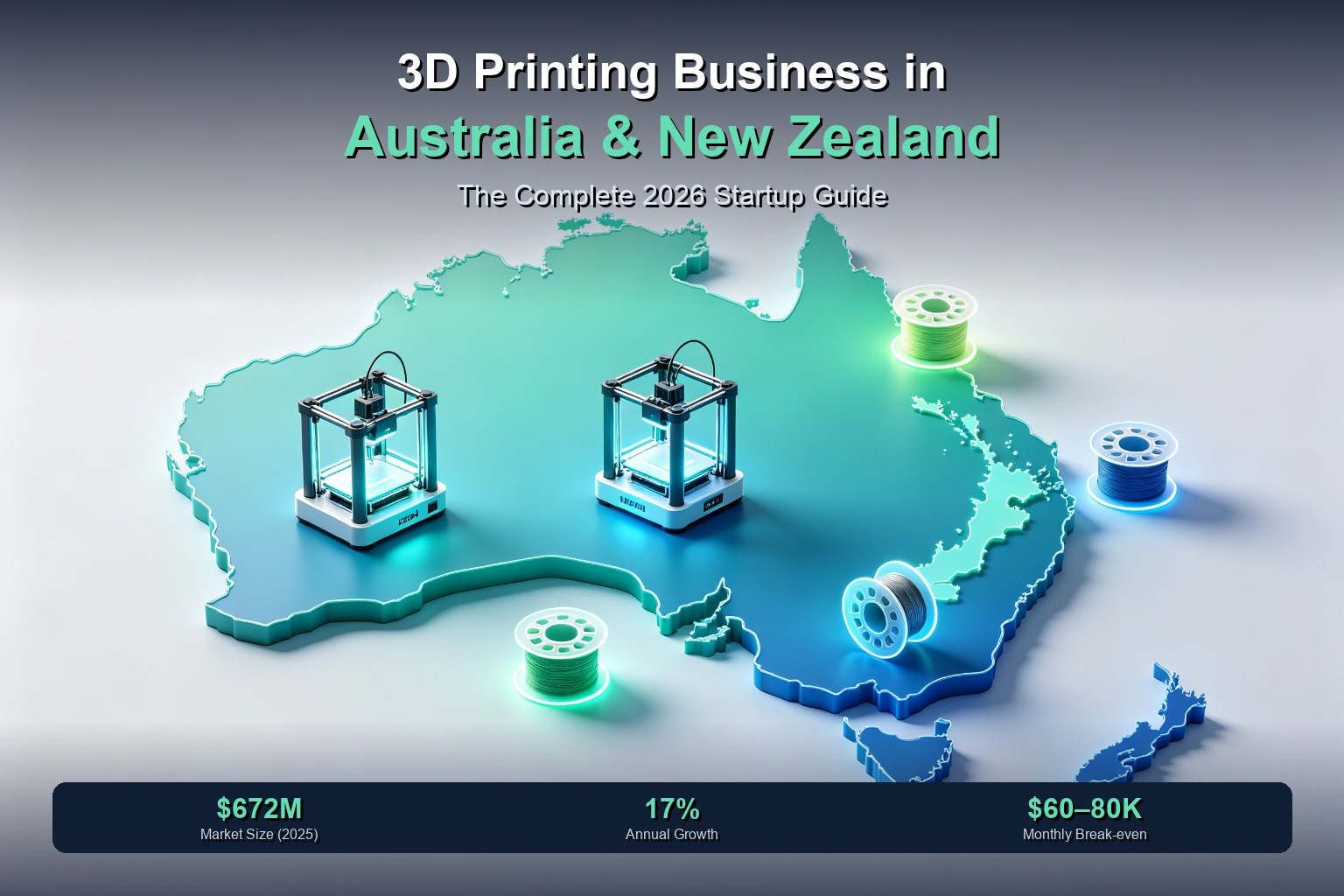
The Complete 2026 Startup Guide
A data-driven breakdown of market opportunity, startup costs, equipment strategy, monthly economics, and revenue models for founders in Australia and New Zealand — including how China-direct sourcing changes the math.
1. Market Overview: Is Australia & NZ a Good Place to Start?
1.1 Market Size and Growth
| Market | 2025 Size | Projected Size | CAGR | Source |
|---|---|---|---|---|
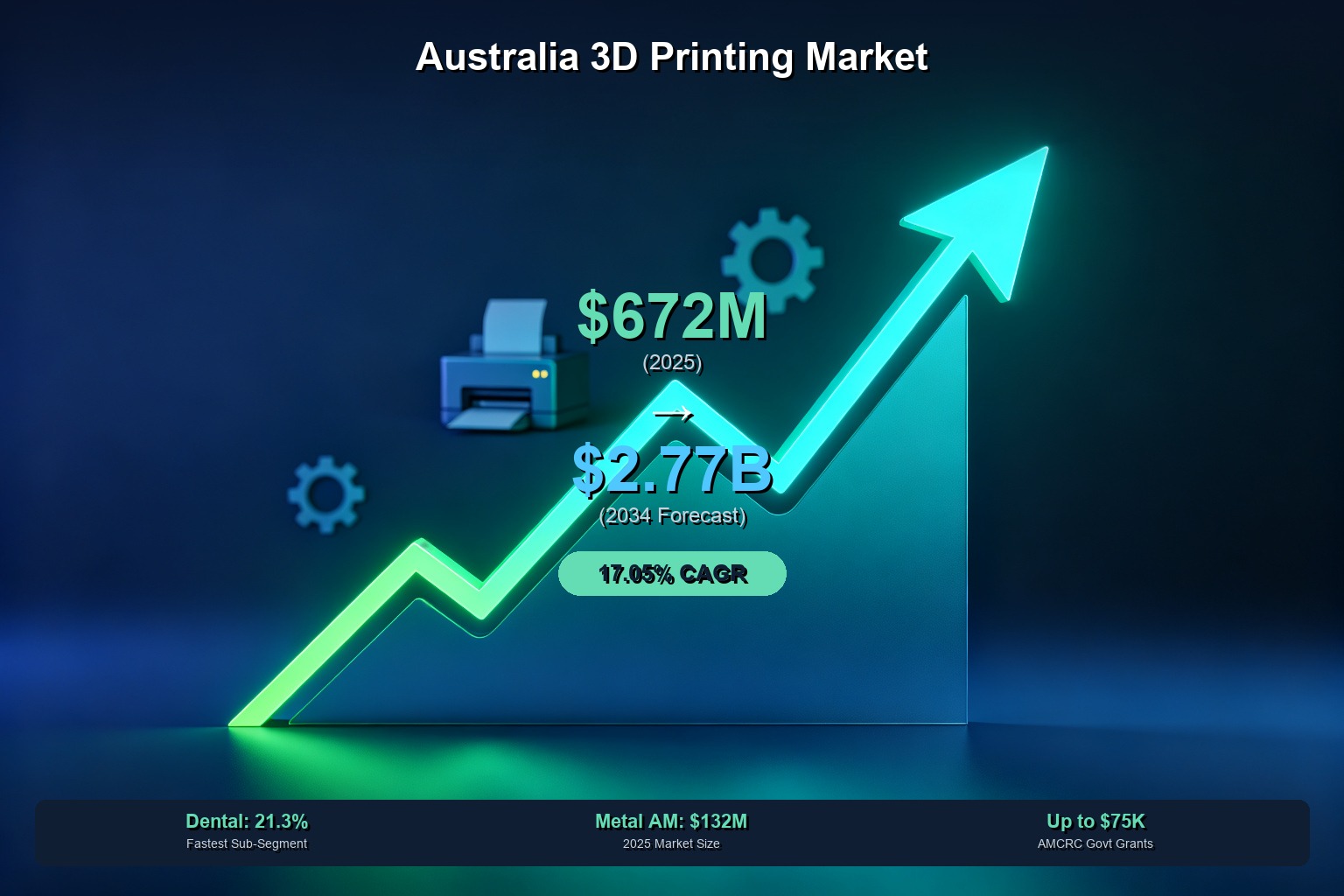
| Australia (total 3D printing) | USD 672.3M (~AUD 1.03B) | USD 2.77B by 2034 | 17.05% | Research and Markets |
| Australia (metal AM) | USD 132.3M | USD 399.3M by 2034 | 12.67% | Industry forecast |
| Australia (dental 3D printing) | USD 26.5M | USD 69.5M by 2030 | 21.3% | MarketsandMarkets |
| New Zealand (estimated) | ~NZD 120–180M | Growing 12–15% annually | 12–15% | Industry estimates |
Australia's 3D printing market is growing at 17% CAGR — faster than the global average of 13.9%. The drivers are unique to the region:
- Geographic isolation: Australia and NZ are far from global manufacturing hubs. Local 3D printing reduces lead times from weeks (overseas shipping) to days, creating a natural "speed premium."
- Government support: Australia's AMCRC (Additive Manufacturing Cooperative Research Centre) offers matched co-funding of AUD 20,000–75,000 for SMEs testing additive manufacturing.
- Housing and construction: Australia's AUD 500B housing shortage is driving interest in 3D-printed concrete. NZ's AMCRETE is the first company to 3D-print full two-storey concrete houses in a single setting.
- Dental and medical: Australia's dental 3D printing market is growing at 21.3% CAGR — the fastest sub-segment.
1.2 The Australia-NZ Advantage: Why Local Service Bureaus Win
| Factor | Australia | New Zealand | Implication |
|---|---|---|---|
| Distance to Asian manufacturing | 7–14 days shipping | 10–18 days shipping | Local 3D printing = 24–72hr turnaround |
| Labour cost (technician) | AUD 28–42/hr | NZD 25–38/hr | Higher than SE Asia, but speed justifies premium |
| Commercial electricity | AUD 0.25–0.45/kWh | NZD 0.18–0.25/kWh | Factor into monthly cost planning |
| Market concentration | Sydney/Melbourne/Brisbane | Auckland/Christchurch/Wellington | Start in a major city, expand regionally |
| Local competition | Moderate (few national players) | Low (mostly hobbyists) | Significant white space for professional service |
Key insight: Both countries have small populations spread over large land areas. This means less direct price competition than the US, but also smaller addressable markets per city. The winning strategy is niche specialization + regional coverage, not a generic "upload your STL" service.
2. Decision Economics: Is It Worth Starting?
2.1 The Honest Answer
A polymer-focused FDM 3D printing service bureau can be a strong small manufacturing business in Australia or NZ — but only above AUD 60,000–80,000/month (NZD 65,000–85,000) in repeatable demand. Below that threshold, you're running an expensive hobby, not a business.
The economics work when the shop:
1. Sells engineering value (design-for-AM, material selection, tolerancing), not just plastic by the gram
2. Fills machine capacity above 55–65% utilization
3. Controls failed builds (target <5% failure rate)
4. Keeps enough working capital to survive 6–12 months of uneven order flow
2.2 Break-Even Targets (AU/NZ)
| Metric | Australia (AUD) | New Zealand (NZD) | Notes |
|---|---|---|---|
| Monthly break-even (lean, owner-operated) | $18,000–25,000 | $20,000–28,000 | Covers rent, materials, utilities, software |
| Monthly break-even (staffed, 1–2 techs) | $45,000–65,000 | $50,000–70,000 | Includes payroll, insurance, marketing |
| Healthy mature net margin | 10–25% | 10–25% | After all costs including owner draw |
| Target machine utilization | 55–65% | 55–65% | Below 40% = losing money on equipment |
2.3 The Most Defensible Angle: Specialization
A general "send us your STL" shop competes with online marketplaces (Xometry, Treatstock, Shapeways) and larger digital manufacturers that can undercut on price. A niche shop that understands one customer segment can charge for confidence:
| Niche | AU/NZ Demand Level | Typical Customer | Why It Works |
|---|---|---|---|
| Engineering prototypes | High | Product startups, mining, defence | AU has strong mining/defence sector; speed matters |
| Architectural models | Medium-High | Architects, property developers | AU/NZ construction boom; high perceived value |
| Dental lab patterns | High (growing 21%) | Dentists, orthodontists | Recurring revenue; regulated but profitable |
| Aftermarket repair parts | High | Farmers, tradies, marine | AU/NZ isolation = broken parts wait weeks; 3D print in days |
| Film/TV props & miniatures | Medium | Production companies, Weta (NZ) | NZ's Weta Workshop ecosystem creates spillover demand |
| Short-run fixtures/jigs | High | Manufacturers, food processing | AU manufacturing reshoring; NZ dairy/agriculture equipment |
| Drone/robotics components | Medium-High | Startups, researchers | AU drone industry growing; NZ agri-drones |
New Zealand-specific opportunity: The dairy industry needs custom milking machine valves and fittings that resist harsh environments. The marine/yachting sector (America's Cup legacy in Auckland) uses carbon-fiber reinforced thermoplastics for custom hydrofoil components. These are high-margin, low-volume niches with almost no local competition.
3. Startup Capital: How Much Does It Really Cost in AU/NZ?
3.1 Realistic Startup Budget
A realistic Australian or New Zealand startup budget is AUD 60,000–380,000 (NZD 65,000–410,000) for a commercial FDM-focused shop. The low end assumes a lean, owner-operated garage/studio setup; the high end assumes a small facility with professional machines, post-processing, and staff.
| Startup Category | Lean Launch (AUD/NZD) | Professional Small Shop (AUD/NZD) | What's Included |
|---|---|---|---|
| Printers & post-processing | $12,000–20,000 | $150,000–200,000 | 3–6 pro FDM (Bambu P2S/A1, Raise3D), drying cabinets, sanding stations, benches, UPS power |
| Workstations, CAD, software | $4,000–6,000 | $20,000–25,000 | High-spec PC, Fusion 360/SolidWorks, slicers, quoting tools, backup |
| Opening materials & consumables | $3,000–5,000 | $25,000–30,000 | PLA, PETG, nylon, engineering filament, nozzles, beds, gloves, bins, packaging, labels |
| Ventilation, safety, PPE | $2,500–4,000 | $20,000–25,000 | Enclosures, exhaust, filtration, PPE, SDS binders, electrical safety, air controls |
| Facility setup & deposits | $6,000–10,000 | $40,000–50,000 | Lease deposit (1–3 months), electrical drops, flooring, benches, security, storage |
| Website, marketing, samples | $3,000–5,000 | $15,000–20,000 | Portfolio, sample kits, local outreach, Google Ads, trade events (Avalon Airshow, Fieldays) |
| Insurance, legal, registration | $2,500–4,000 | $12,000–15,000 | Entity registration, public liability, professional advice, contract templates |
| Working capital reserve | $30,000–40,000 | $90,000–120,000 | 3–4 months of rent, payroll, materials, utilities, slow collections |
| TOTAL | $63,000–94,000 | $372,000–485,000 |
3.2 Australia-Specific Registration Costs
| Item | Cost | Notes |
|---|---|---|
| ABN (Australian Business Number) | Free | Apply via abr.gov.au, instant to 20 min |
| Business name (1 year) | $47 | ASIC fee |
| Business name (3 years) | $108 | ASIC fee |
| Pty Ltd company registration | $636 | ASIC fee; recommended for liability protection |
| Annual ASIC review fee | $329 | Standard proprietary company |
| GST registration | Free | Mandatory above $75K turnover; recommended for B2B |
| Public liability insurance | $500–2,000/year | Essential for client-facing prototyping |
| Workers compensation | Varies by state | Required if employing staff |
3.3 New Zealand-Specific Registration Costs
| Item | Cost (NZD) | Notes |
|---|---|---|
| NZBN (New Zealand Business Number) | Free | Automatic with company registration |
| Company registration (Ltd) | $117 + GST | Online via Companies Office |
| Annual return filing | $60 + GST | Due each year |
| GST registration | Free | Mandatory above $60K turnover |
| Public liability insurance | $600–2,500/year | Essential |
| ACC levies | Based on payroll | Employer contribution, ~1–3% of payroll |
3.4 The China-Direct Sourcing Advantage (Your Secret Weapon)
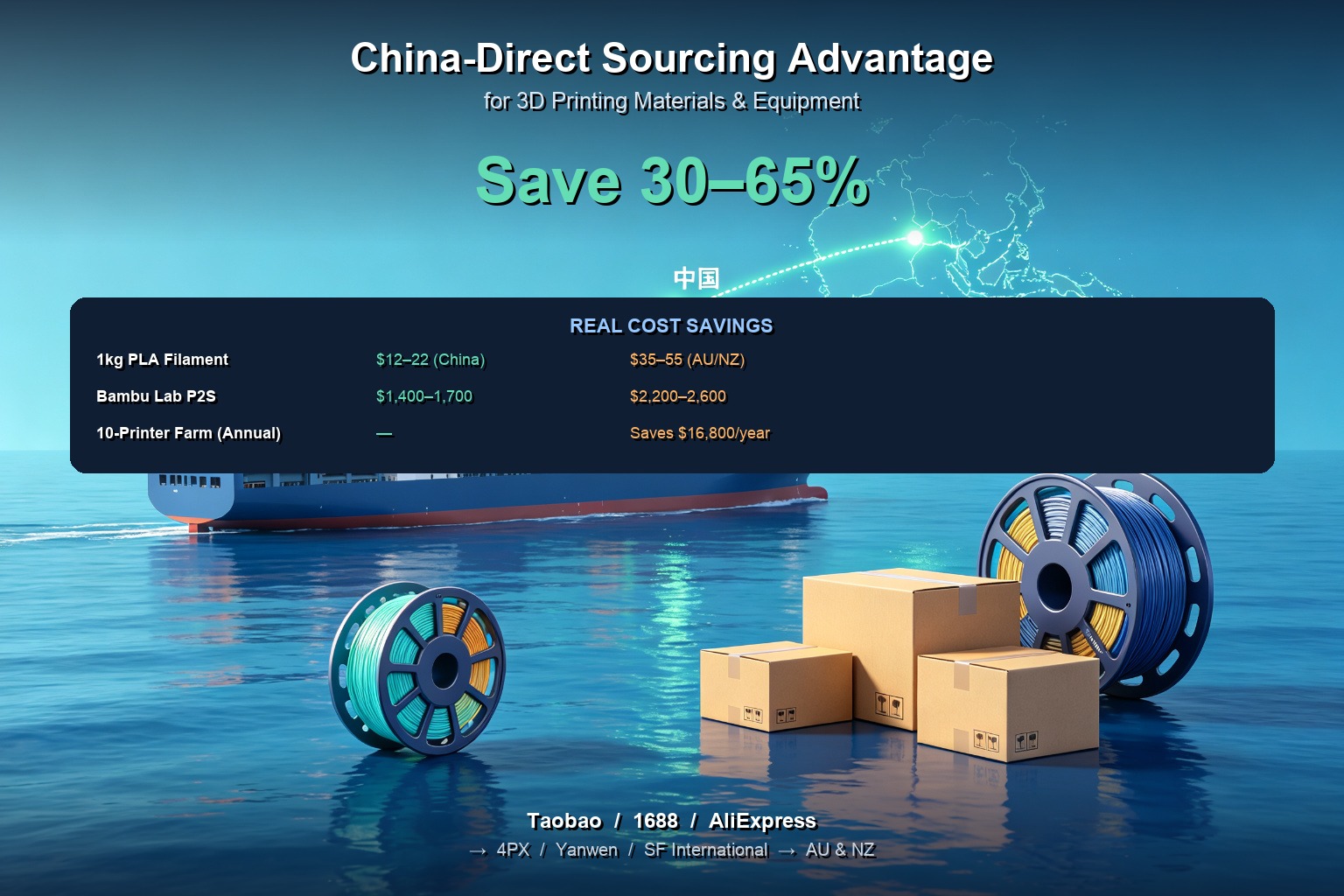
This is where your knowledge of Chinese e-commerce and freight forwarders creates a structural cost advantage over local competitors who buy from Australian/NZ resellers:
| Item | AU/NZ Reseller Price | China-Direct Price (Taobao/1688/AliExpress) | Savings |
|---|---|---|---|
| Bambu Lab P2S (imported) | AUD 2,200–2,600 | AUD 1,400–1,700 (incl. shipping) | 30–35% |
| 1kg PLA filament (brand) | AUD 35–55 | AUD 12–22 (incl. freight) | 50–65% |
| 1kg PETG/engineering | AUD 45–75 | AUD 18–30 | 55–65% |
| Nozzles, beds, spare parts | AUD 20–80 each | AUD 3–15 each | 70–85% |
| Build plates (textured PEI) | AUD 40–70 | AUD 10–25 | 60–75% |
For a 10-printer farm consuming 50kg/month of filament:
- AU reseller: 50 × AUD 45 = AUD 2,250/month
- China-direct: 50 × AUD 17 = AUD 850/month
- Annual savings: AUD 16,800
This alone can cover 1–2 months of rent. The key is using reliable freight forwarders (4PX, Yanwen, SF International) and ordering in bulk (10–20 spools at a time) to amortize shipping costs.
4. Technology Mix: Which FDM Printers to Buy First
4.1 The Core Fleet Philosophy
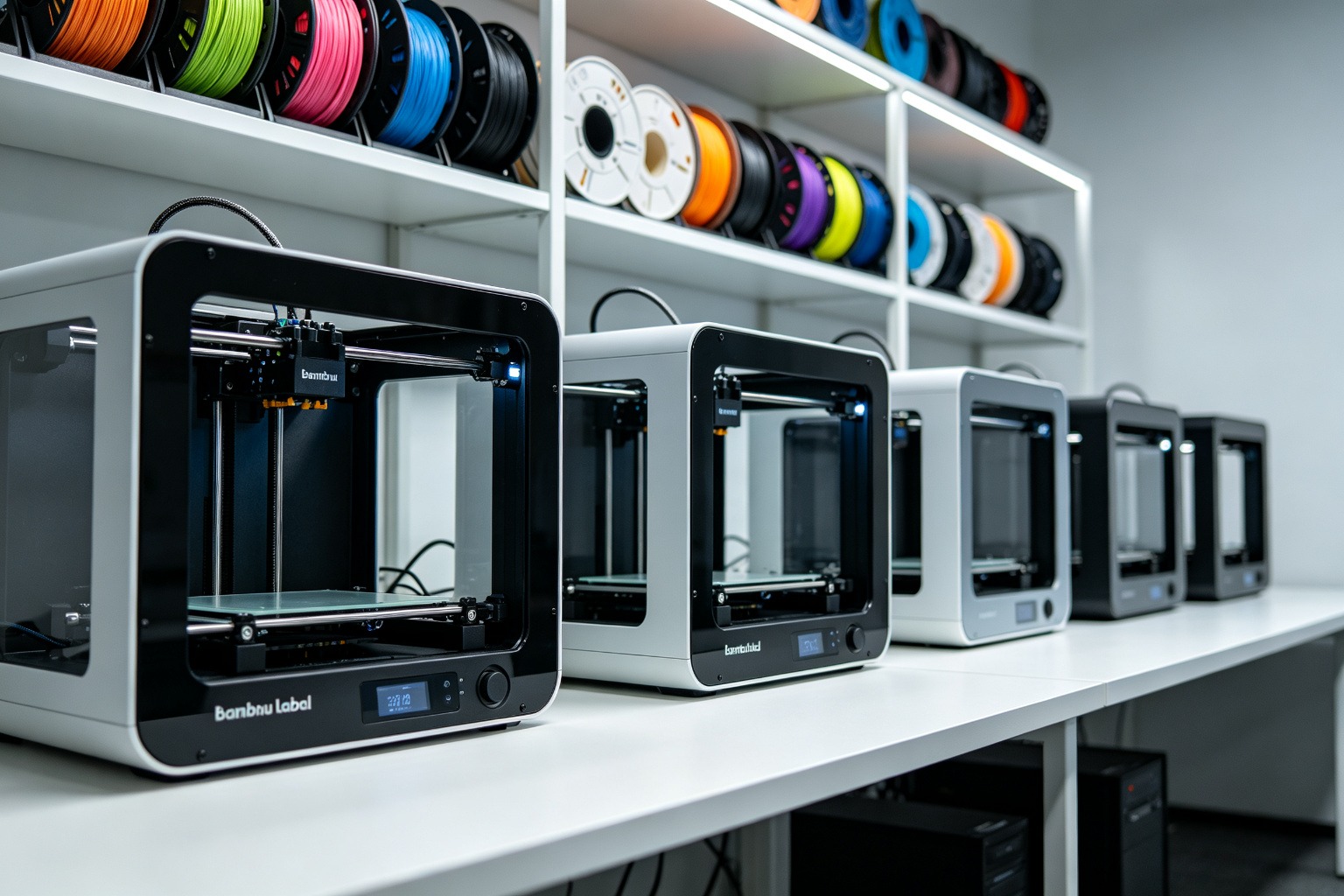
Buy redundancy before prestige. Two reliable AUD 1,500 machines (Bambu P2S) make more launch sense than one AUD 30,000 machine, because downtime, nozzle clogs, and calibration days are not billable.
| Fleet Tier | Machines | Total Cost (AUD) | Best For |
|---|---|---|---|
| Entry (lean) | 2× Bambu P2S + 1× Bambu A1 | $4,000–6,000 | Prototyping, functional parts, testing demand |
| Growth | 3× Bambu P2S + 2× Bambu A1 | $7,000–11,000 | Professional service, multi-material, higher throughput |
| Professional | 4× Bambu P2S + 2× Raise3D Pro3 + 1× large-format | $25,000–45,000 | Production runs, large parts, industrial clients |
| Industrial | Large-format + engineering-grade systems | $100,000+ | Only after proving $100K+/month demand |
4.2 Why Bambu Lab Dominates the AU/NZ Entry Market
| Printer | AUD Price | Print Volume | Power (PLA) | Why It Fits AU/NZ |
|---|---|---|---|---|
| Bambu Lab P2S | $1,500–1,800 | 256×256×256mm | 200W steady, 1000W peak @110V | Best speed/reliability/price ratio; AMS for multi-color |
| Bambu Lab A1 | $900–1,200 | 257×257×257mm | ~90W avg, 350W peak @110V | Lower power = easier circuit setup; great for farms |
| Raise3D Pro3 Plus HS | $6,000–7,000 | 300×300×605mm | Higher | Large-format; industrial clients, tall fixtures |
| Creality K2 Plus | $1,800–2,400 | 300×300×300mm | 132W avg PLA | Budget large-volume option; good for farm expansion |
| Bambu Lab X1C | $3,000–3,800 | 256×256×256mm | Higher | Carbon fiber and engineering materials; enclosed chamber |
Critical for AU/NZ: All these machines run on 100–240V, so they work in both countries without voltage converters. The P2S's 1000W peak at 110V is manageable on a standard 10A AU/NZ power point (2400W), but a 10-printer farm needs dedicated circuits — plan electrical capacity before signing a lease.
4.3 Material Strategy for AU/NZ
| Material | AU/NZ Price Range (per kg) | Best Applications | China-Direct Savings |
|---|---|---|---|
| PLA | AUD 12–35 | Prototypes, display models, low-stress parts | 50–65% |
| PETG | AUD 18–45 | Outdoor parts, food-safe (certain grades), watertight | 55–65% |
| ABS/ASA | AUD 25–55 | Automotive, outdoor, heat-resistant | 50–60% |
| Nylon (PA) | AUD 35–75 | Functional parts, gears, hinges | 55–65% |
| Carbon fiber PLA/PETG/PA | AUD 30–65 | Stiff parts, drone frames, marine | 50–60% |
| TPU/TPE (flexible) | AUD 25–55 | Gaskets, grips, seals | 50–60% |
Stock recommendation for launch: 70% PLA/PETG (volume), 20% ABS/ASA/nylon (engineering), 10% specialty (carbon fiber, TPU). Buy PLA and PETG in bulk from China; keep engineering materials in smaller quantities from local suppliers for fast turnaround.
5. Launch Path: How to Start Without Overbuying
5.1 The Customer-First Sequence
The cleanest launch is customer-first, not machine-first. Prove repeat demand before signing a lease.
| Phase | Timeline | Actions | Budget (AUD/NZD) |
|---|---|---|---|
| Phase 0: Validate | Weeks 1–3 | Pick niche, build 5–10 sample parts, create landing page, test demand with local businesses | $500–2,500 |
| Phase 1: Launch | Weeks 4–8 | Buy 2–3 core FDM machines, materials, finishing tools; start taking paid orders | $12,000–30,000 |
| Phase 2: Sell | Months 3–5 | Outreach to engineers, schools, makers, manufacturers, dental labs; reserve 10–15% capacity for reprints | $5,000–15,000 (marketing) |
| Phase 3: Scale | Months 6–12 | Add equipment only when booked hours >55–65% of capacity AND backlog is profitable | $20,000–60,000 |
5.2 Australia-Specific Launch Tactics
1. Attend trade events: Avalon Airshow (defence/aviation), National Manufacturing Week, Fine Food Australia (food processing fixtures), DesignBUILD (architectural models)
2. State government grants: Most states offer small business grants (AUD 5,000–25,000) for digital adoption and manufacturing. Check your state's Department of Industry.
3. AMCRC co-funding: If you're serving an SME manufacturer, apply together for AUD 20K–75K matched funding.
4. Local SEO: Target "[city] 3D printing service" — competition is low in AU suburbs.
5. Cold outreach to tradies: Plumbers, electricians, and farmers constantly need custom replacement parts that are "on backorder from overseas for 6 weeks."
5.3 New Zealand-Specific Launch Tactics
1. Fieldays (Hamilton): The largest agricultural event in NZ — perfect for showcasing custom farm equipment parts.
2. Auckland marine cluster: America's Cup legacy means high demand for custom yacht fittings and hydrofoil components.
3. Weta Workshop ecosystem: Wellington's film/TV effects industry creates spillover demand for props and miniatures.
4. Dairy industry: Waikato and Canterbury farms need custom milking machine valves and fittings.
5. Regional advantage: NZ regional businesses have even less access to local manufacturing — a regional service bureau can command premium pricing.
5.4 Legal and Compliance Checklist
| Requirement | Australia | New Zealand |
|---|---|---|
| Business entity | Sole trader (free ABN) or Pty Ltd ($636) | Sole trader or Ltd ($117+GST) |
| GST registration | Mandatory >$75K turnover | Mandatory >$60K turnover |
| Public liability insurance | $500–2K/year | $600–2.5K/year |
| Workplace health & safety | State-based (SafeWork) | WorkSafe NZ |
| Electrical safety | AS/NZS 3000 wiring rules | AS/NZS 3000 (adopted) |
| Client contracts | Limit liability for prototypes, tolerances, IP | Same — use NZ-specific terms |
| Consumer guarantees | ACL (Australian Consumer Law) | CGA (Consumer Guarantees Act) |
Critical: If a client wants a part for medical, aerospace, automotive, food-contact, or load-bearing use, your contract must explicitly disclaim fitness for purpose. A prototype for a trade show is very different from a part someone wants to install in a load-bearing application.
6. Monthly Operating Costs: AU/NZ Reality
6.1 Monthly Burn Rate
| Monthly Expense | Lean Shop (AUD) | Staffed Shop (AUD) | Lean Shop (NZD) | Staffed Shop (NZD) |
|---|---|---|---|---|
| Rent & utilities | $2,000–3,500 | $8,000–12,000 | $2,200–3,800 | $8,500–13,000 |
| Payroll (1–2 techs) | $6,000–8,000 | $22,000–32,000 | $6,500–9,000 | $24,000–35,000 |
| Materials & consumables | $2,000–4,000 | $12,000–18,000 | $2,200–4,500 | $13,000–20,000 |
| Repairs & maintenance | $800–1,500 | $5,000–8,000 | $900–1,700 | $5,500–9,000 |
| Software & cloud | $300–500 | $2,000–3,500 | $350–550 | $2,200–3,800 |
| Insurance & compliance | $300–500 | $1,500–2,500 | $350–550 | $1,600–2,800 |
| Marketing & sales | $1,000–2,000 | $5,000–8,000 | $1,100–2,200 | $5,500–9,000 |
| Shipping & packaging | $700–1,200 | $4,000–6,000 | $800–1,300 | $4,500–6,500 |
| Equipment payments | $1,000–2,000 | $8,000–12,000 | $1,100–2,200 | $9,000–13,000 |
| TOTAL | $13,800–23,000 | $67,500–102,000 | $15,150–25,550 | $73,800–112,100 |
6.2 Electricity Planning for Print Farms
Electricity is a meaningful operating cost in both countries, especially for multi-printer farms. Plan your electrical capacity before signing a lease.
| Farm Size | Total Peak Power (10× P2S) | Circuit Requirement (AU/NZ 240V) | Monthly Electricity Estimate |
|---|---|---|---|
| 3 printers | ~3,000W peak | 1× 15A dedicated circuit | AUD 120–200 / NZD 90–160 |
| 5 printers | ~5,000W peak | 1× 20A or 2× 10A circuits | AUD 200–350 / NZD 150–280 |
| 10 printers | ~10,000W peak | 2–3× 20A circuits or 3-phase | AUD 400–700 / NZD 300–560 |
| 20 printers | ~20,000W peak | 3-phase power required | AUD 800–1,400 / NZD 600–1,100 |
Key planning points:
- Australian commercial rates: AUD 0.25–0.45/kWh (SA highest, QLD/NSW lowest)
- New Zealand commercial rates: NZD 0.18–0.25/kWh (regional can be 40% higher)
- A 10-printer farm running 20h/day consumes ~8,700 kWh/month — budget accordingly
- Consider solar panels for AU operations — feed-in tariffs and high daytime rates make ROI attractive
- Negotiate a time-of-use tariff and schedule large build plates for off-peak hours (typically 10pm–7am)
6.3 Labour Costs
| Role | Australia (AUD/hr) | New Zealand (NZD/hr) | Annual Cost (AU) | Annual Cost (NZ) |
|---|---|---|---|---|
| Junior technician (1–2 yr exp) | $28–35 | $25–32 | $55K–68K | $50K–64K |
| Senior technician/CAM operator | $38–50 | $34–45 | $74K–98K | $67K–88K |
| CAD designer (part-time) | $40–60 | $36–55 | $45K–70K (p/t) | $40K–65K (p/t) |
| Owner/founder (draw after break-even) | $70,000–120,000/yr | $75,000–130,000/yr | — | — |
Superannuation (AU): 11.5% on top of wages (rising to 12% by 2027).
ACC (NZ): ~1–3% employer contribution on payroll.
7. Revenue Architecture: How to Price and Profit
7.1 Five Revenue Streams
| Revenue Stream | AU Price Range | NZ Price Range | Margin | Best Customer |
|---|---|---|---|---|
| Prototype print jobs (FDM) | A$80–700/order | NZ$90–770/order | Good if files are clean | Product teams, startups, students |
| Small-batch production | A$600–10,000/run | NZ$660–11,000/run | Best when setup repeats | Manufacturers, robotics, e-commerce |
| CAD/design-for-AM help | A$70–150/hr | NZ$77–165/hr | High gross margin | Customers with ideas, broken files |
| Finishing & post-processing | A$30–300/job | NZ$33–330/job | Profitable only if quoted explicitly | Architects, props, presentation |
| Rush/guaranteed turnaround | 20–100% premium | 20–100% premium | Attractive with spare capacity | Engineers, trade shows, maintenance |
7.2 AU/NZ FDM Market Pricing Reference
| Service | Australia (AUD) | New Zealand (NZD) |
|---|---|---|
| Standard FDM part (PLA/PETG, small) | $30–150 | $35–165 |
| Large-format FDM part (>200mm) | $100–500 | $110–550 |
| Engineering material (nylon/ABS/ASA) | $80–400 | $90–440 |
| Carbon fiber reinforced | $100–600 | $110–660 |
| CAD design (per hour) | $70–150 | $77–165 |
| Rush fee (24hr turnaround) | +50–100% | +50–100% |
| Batch discount (10+ identical parts) | −15–30% | −15–30% |
7.3 The Pricing Formula (Don't Use $/Gram)
Quote Price = File Review + Setup + Machine Hours + Materials + Failure Reserve (10–15%) + Finishing Labor + Overhead Recovery + Target Profit (20–30%)
A simple $/gram model misses the two lines that decide profit in AU/NZ: technician time (expensive at AUD 28–50/hr) and failure reserve (shipping replacement parts to regional AU/NZ costs more than in the US).
Example quote (AU): A small batch of 20 PETG brackets
- File review & setup: $40
- Machine time (2× P2S, 8hr): $160
- Materials (0.8kg PETG @ $17/kg China-direct): $14
- Failure reserve (12%): $26
- Finishing (sanding, 1hr @ $40): $40
- Overhead recovery: $60
- Target profit (25%): $85
- Total quote: $425 (AUD)
- Per-part: $21.25 — competitive with overseas quotes once shipping and wait time are considered
8. Risks and Challenges Specific to AU/NZ
| Challenge | Australia | New Zealand | Mitigation |
|---|---|---|---|
| Small market per city | Sydney ~5.3M, Melbourne ~5.1M | Auckland ~1.7M | Specialize vertically, sell nationally via shipping |
| High electricity costs | SA up to $0.45/kWh | Regional up to $0.35/kWh | Solar panels, off-peak scheduling, energy-efficient printers |
| Equipment import costs | GST + customs + freight | GST + customs + freight | China-direct sourcing, bulk orders, local distributor relationships |
| Skilled labor shortage | Techs hard to find | Even harder | Train juniors, use Bambu user-friendly ecosystem |
| Distance from suppliers | Spare parts take 1–2 weeks | 2–3 weeks | Stock critical spares (nozzles, beds, thermistors) |
| Seasonal demand | Dec/Jan slow (holidays) | Dec/Jan slow | Build cash reserves, target industries with opposite cycles |
| Compliance burden | State-based WHS | WorkSafe NZ | Budget for compliance, get professional advice early |
9. 12-Month Implementation Roadmap
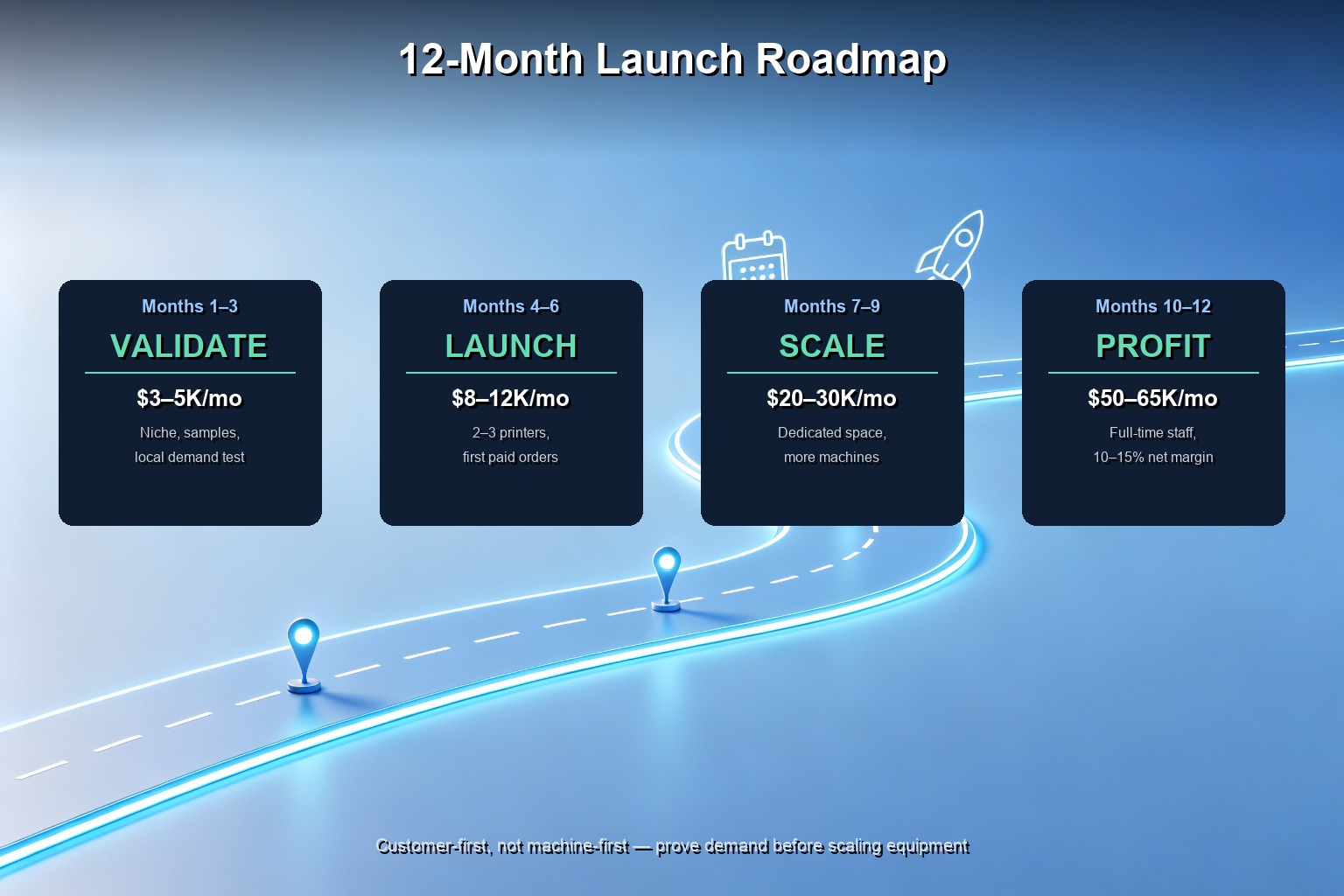
| Month | Key Actions | Milestone |
|---|---|---|
| 1 | Register ABN/NZBN, pick niche, build 10 sample parts, create website | Business live, samples ready |
| 2 | Buy 2× Bambu P2S + 1× A1, set up workspace, start quoting | First 3 paid orders |
| 3 | Outreach to 50 local businesses, attend 1 industry event | $3,000–5,000 monthly revenue |
| 4–5 | Refine quoting system, add 1 more printer if utilization >55% | $8,000–12,000 monthly revenue |
| 6 | Review financials, decide on lease/space upgrade, hire part-time help | Break-even or close |
| 7–8 | Move to dedicated space (if needed), add large-format or engineering printer, build portfolio | $20,000–30,000 monthly revenue |
| 9–10 | Launch niche marketing campaign, apply for grants, add 2–3 printers | $35,000–50,000 monthly revenue |
| 11–12 | Hire full-time technician, implement QC system, plan Year 2 expansion | $50,000–65,000 monthly revenue, 10–15% net margin |
10. Conclusion
Australia and New Zealand offer a structurally attractive market for FDM 3D printing service bureaus: growing demand (17% CAGR in AU), limited local competition, geographic isolation that justifies speed premiums, and government support for additive manufacturing. The challenges — high electricity, small per-city markets, import costs — are real but manageable with the right strategy.
The three pillars of success in AU/NZ are:
1. Niche specialization — pick one industry (dental, mining, agriculture, marine) and dominate it locally
2. China-direct sourcing — your knowledge of Taobao/1688/AliExpress and freight forwarders gives you a 30–65% cost advantage on materials and equipment
3. Capacity discipline — buy machines only when utilization consistently exceeds 55%; avoid the trap of owning idle equipment
A lean launch can start for AUD 63,000–94,000 (NZD 65,000–100,000) and reach break-even within 6–9 months if customer validation is done before equipment purchases. The professional path (AUD 370K+) should only be taken after monthly revenue consistently exceeds AUD 50,000.
The market is growing, the competition is manageable, and the cost advantages are real. The question isn't whether to start — it's whether you can resist the temptation to overbuy equipment before proving demand.
Sources
Research and Markets (Australia 3D printing market 2025–2034), MarketsandMarkets (Australia dental 3D printing), AMCRC co-funding program, AER (Australian electricity rates), Electricity Authority NZ, ASIC registration fees, Companies Office NZ, Zeal3DPrinting pricing guide, Bambu Lab official power specifications, industry interviews and service bureau operator reports (2025–2026).