AltForm Unveils Print Brilliance 400: A Four-Laser Metal 3D Printer Built for Production, Not Prototyping
AltForm, the Italian additive manufacturing company formerly known as Prima Additive, has launched the Print Brilliance 400 — a four-laser metal 3D printer designed for industrial-scale powder bed fusion. The machine is the flagship of AltForm's Print 400 series and is on display at IMTS 2026 in Chicago this week.
The specs read like a production-oriented spec sheet rather than a showpiece. A 430 × 430 × 450 mm build volume. Four lasers that each cover the entire build platform, not just a section of it. A stated build rate of up to 4 × 100 cm³ per hour. Adjustable layer thickness from 20 to 120 micrometers. AltForm is not positioning this as a research tool — it is positioning it as a shop-floor machine that needs to run eight hours a day.
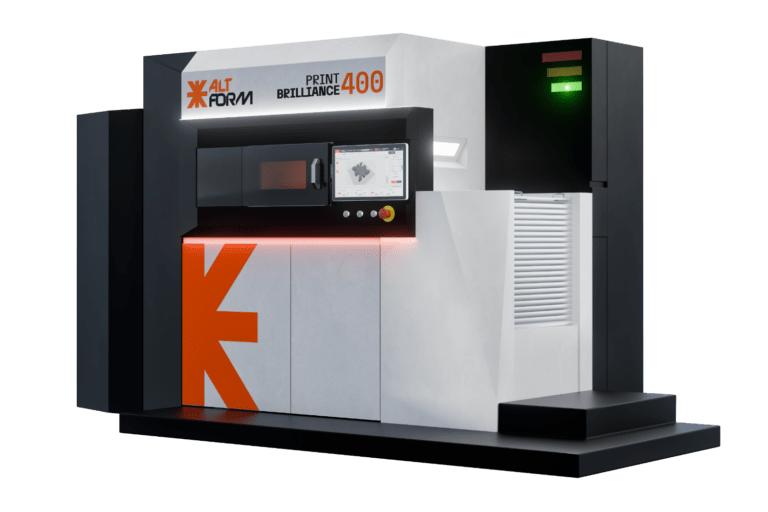
The AltForm Print Brilliance 400 at IMTS 2026. The machine uses a four-laser, full-overlap LPBF architecture in a 430 × 430 × 450 mm build chamber. Image: AltForm.
What Makes the Four-Laser Architecture Different
Multi-laser metal 3D printing is not new. Most production LPBF systems on the market now ship with two, four, or even six lasers. But how those lasers divide the build plate matters more than the laser count itself.
On many multi-laser systems, the build area is split into zones. Laser 1 handles the left portion, laser 2 handles the right, and so on. At the boundary between zones, parts experience a slightly different thermal history. In practice, this can show up as a subtle seam — a band of different surface finish, microstructure, or mechanical properties where two lasers hand off.
AltForm's design takes a different approach. Every one of the four lasers can reach the entire build platform. The company calls this "full overlap." There are no fixed zones. The build software assigns laser tasks based on part geometry, not on which laser happens to own that quadrant.
This matters for large parts. A 400 mm injection molding insert that spans most of the build plate will be melted consistently by whichever laser is available, rather than being split across a seam line. It also matters for redundancy. If one laser needs attention, the remaining three can keep the build running — or the build can be re-segmented to compensate.
| Specification | Value |
|---|---|
| Build volume (standard) | 430 × 430 × 450 mm |
| Build volume (XL variant) | 420 × 420 × 1000 mm (Z-axis) |
| Laser count | 4 (full-overlap, each laser reaches full build area) |
| Build rate | Up to 4 × 100 cm³/h (400 cm³/h total) |
| Layer thickness | 20–120 μm, adjustable |
| Powder handling | Manual to fully automated closed-loop (configurable) |
| Chamber extraction | Automatic, supports external depowdering |
Productivity Is the Real Story
Metal 3D printing has spent the last decade proving that it can produce strong, accurate parts. The current challenge is throughput. A single-laser LPBF machine might remove 5–15 cm³ per hour. The Print Brilliance 400's four-laser setup reaches 400 cm³ per hour at maximum build rate — an order of magnitude higher.
That kind of number changes the economics. At 400 cm³/h, a full build plate of small to medium parts can run in a single shift. For a service bureau or an in-house production team, that means the machine is earning money during the hours it is actually running, not sitting idle between depowdering and post-processing.
AltForm has also built the automation around the machine rather than treating it as an afterthought. The automatic chamber extraction system moves the build plate out to an external depowdering station, so the next build can start while the previous one is being cleaned. Powder handling ranges from manual loading for low-volume shops to fully closed-loop automated powder recycling for high-volume production lines. This is the architecture you would expect from a company that has been building industrial laser systems for decades — AltForm is the rebranded Prima Additive, part of the Prima Industrie group, now under Sodick ownership.
Where It Fits in the Market
The large-format, multi-laser LPBF segment is crowded. EOS, SLM Solutions, Trumpf, DMG Mori, and Farsoon all offer machines with similar build volumes and four-laser configurations. The Print Brilliance 400 does not stand out on raw laser count alone. What sets it apart is the combination of full-overlap optics, the XL build height option (up to 1,000 mm on the Z axis), and the modular powder handling that lets a buyer start small and scale without replacing the machine.
For mold and die shops, the use case is concrete. Conformal cooling channels in injection molding inserts can be designed and printed in one piece, cutting cycle times by 10–30% on parts that need tight temperature control. A 430 × 430 mm build plate is large enough for most mold inserts and die components. The XL variant addresses longer parts — turbine blades, long ducting, structural components — that standard-height machines cannot accommodate.
For aerospace and automotive production, the productivity number is the headline. Four lasers at 100 cm³/h each means a typical build finishes in hours, not days. In a regulated industry where part qualification already exists, the bottleneck is usually machine time, not design or material science. A faster machine directly translates to more parts per month.
What We Don't Know Yet
Several key details have not been announced. AltForm has not released pricing for the Print Brilliance 400, though large-format four-laser LPBF systems in this class typically fall in the high-end industrial range. The per-laser wattage is not specified in the available materials, which makes it hard to compare directly with competitors advertising 500 W or 1 kW fiber lasers. The qualified material list, delivery timeline, and service network outside Europe have also not been confirmed.
These gaps matter for procurement. A machine's headline build rate is only achievable with the right combination of laser power, scan strategy, and material. Without knowing which metals are qualified (and at what layer thickness and scan speed the 400 cm³/h figure applies), buyers should treat the productivity number as a best-case figure, not a floor. Standard due diligence — requesting a sample build of representative parts, asking for material qualification documents, and verifying the depowdering workflow — will tell the real story.
Outlook
AltForm is betting that production-focused buyers care less about flashy demos and more about uptime, repeatability, and how quickly a build can go from powder to packaged part. The Print Brilliance 400 is built around that bet. The company has the manufacturing heritage (Prima Industrie has been making laser systems since the 1970s) and the recent investment backing (Sodick's acquisition) to support a serious push into industrial metal additive manufacturing.
Whether it succeeds against established competitors will come down to execution: service response, material qualification speed, and pricing that makes the machine economically viable at scale. The IMTS 2026 showing gives potential customers in North America their first hands-on look. For buyers evaluating large-format LPBF systems in the next 12 months, the Print Brilliance 400 deserves a spot on the shortlist — but the request for quote and the sample build should come before any purchase decision.