Tool Changer. Game Changer. Why Bambu's H3C Matters for Anyone Selling Prints
Bambu Lab is pulling the cover off the H3C today. The slogan on the teaser page was five words: "Tool Changer. Game Changer." We'll leave the spec sheet to the reveal. What matters for people who sell prints is whether that slogan holds up.
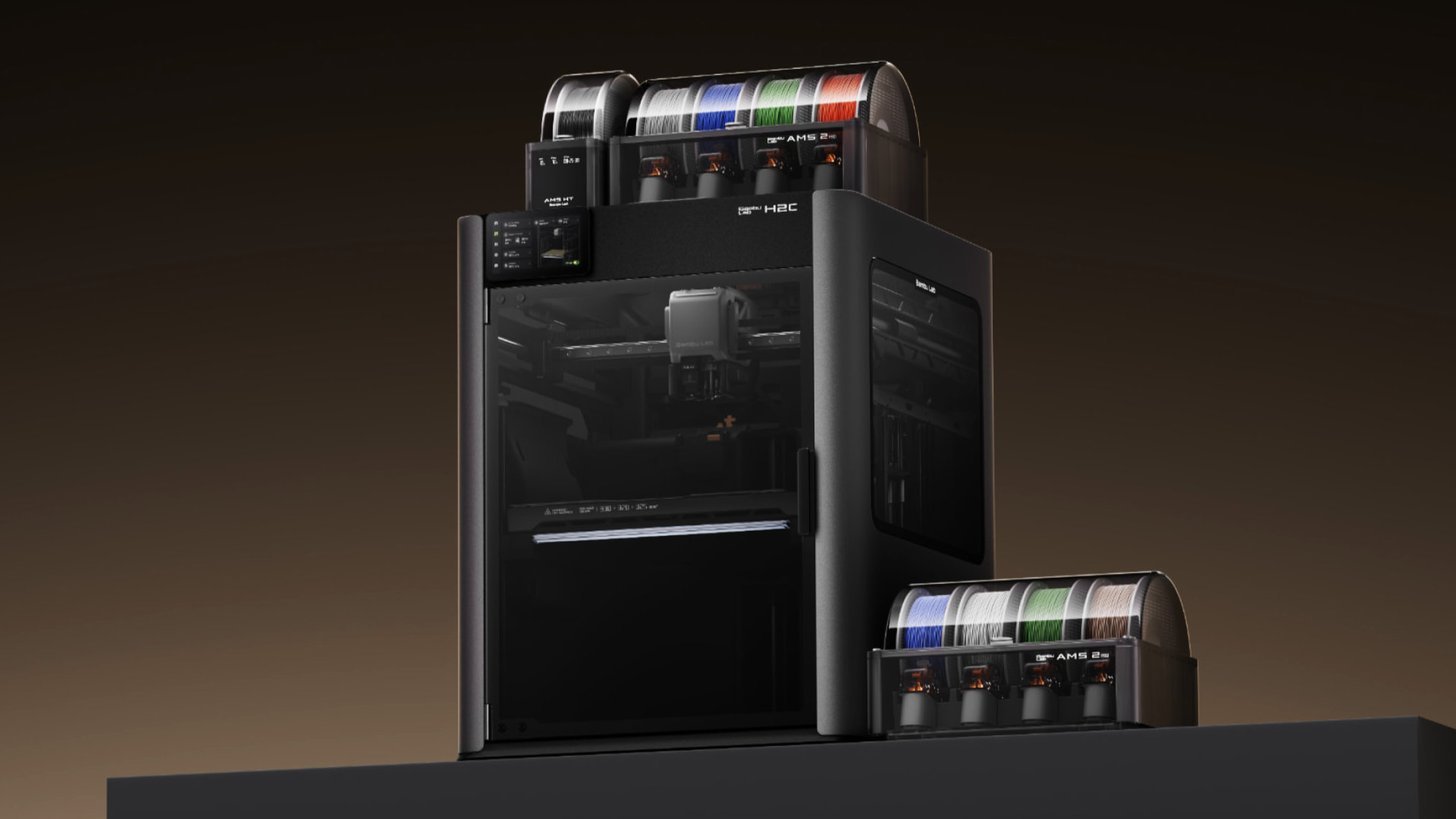
The Bambu H2C (pictured) is today's Vortek hotend-changer. The H3C, revealed today, takes the same idea to nine full tool heads.
What's actually new
Most multicolor printers you can buy today feed several filaments through one nozzle. That's how Bambu's own AMS works. It's cheap and it's good, but every color change purges a gob of plastic into what the community calls "printer poop" — a tower of mixed-color waste that goes straight in the bin.
Bambu's last attempt at fixing this was the H2C. It doesn't purge. It swaps the whole hotend. Up to seven hotends sit in a rack, each preloaded, and the printer docks and picks the right one. Bambu's own numbers say the H2C throws away 532 g of purge plastic on a complex test model, versus 3,032–3,917 g on a comparable single-nozzle multicolor setup. That's the waste math that matters.
The H3C goes a step further. It's not a hotend swap — it's a full tool changer. Nine independent tool heads sit on the rack, each with its own nozzle, heater, and cooling. A print switches color or material by picking up a different tool. No purge tower. No ooze. Theoretically, you run PLA, PETG, TPU, and a dissolving support in one job without unloading anything.
Why sellers should care
If you're printing one decor piece a week for yourself, a tool changer is a nice-to-have. If you run an Etsy shop or a small print farm, the waste number is the whole story.
On a four-color figurine that uses 80 g of part material, an AMS job can dump another 30–50 g into a purge tower. At roughly $25/kg that's under a dollar per print, which sounds trivial — until you're running fifty multicolor jobs a week and throwing away $30–60 a month on plastic you never sell. Multiply that by twelve and the H2C, or eventually the H3C, pays for itself in avoided filament. For a print farm, that's not a feature. It's margin.
The second thing sellers care about is material flexibility. A single-nozzle multicolor system locks you into one material family for the whole print. A tool changer doesn't. You can print a TPU flexible gasket body over a rigid PETG shell, or use a dissolving support material for overhangs that would otherwise need manual cleanup. That opens up products you couldn't profitably make before — cases with living hinges, snap-fit enclosures, functional parts that need both stiffness and give.
Nine tools is headroom, not a target
It's easy to hear "nine tools" and picture nine-color rainbow prints on every listing. Don't.
Most sellers will load two or three tools most of the time. PLA in one, PETG in another, maybe TPU in the third. The nine slots are there so you can leave materials loaded across jobs instead of unloading and reloading between orders. That's the real win for a small shop — not rainbow prints, but no more "unload the green, load the black, unload the black, load the red" between every order.
It also means the H3C is future-proof in a way the H2C isn't. When Bambu ships a hardened-steel tool for abrasive fill materials, or a high-flow tool for nylon, you buy the tool — not a new printer.
What's still unknown
Price is the obvious one. The H2C currently sells for $2,699 in the US. A nine-tool machine with the software and mechanics Bambu is promising will not be cheaper. If the H3C lands near $3,500–$4,500, it's a business tool, not a hobby upgrade. If it surprises and lands near $2,800, that's a different conversation.
Software is the quieter risk. Tool changers only work if the slicer coordinates swaps cleanly — which tool is parked where, what material is loaded, when to dock and wipe. Bambu Studio is polished for the AMS, but full tool-changer support is a harder problem, and the H2C's rollout showed how long a new multi-tool system needs to mature.
Maintenance is the third. Nine tool heads is nine sets of nozzles, heaters, fans, and thermistors to keep clean and replace. On a printer that's supposed to reduce hassle, that's a real tradeoff — the kind reviewers find three months in, not at launch.
Who should do what today
If you're already running an AMS machine, the H3C doesn't make you upgrade. Your current printer still works, and purging, while wasteful, is predictable and cheap enough for low volume.
If you're about to buy your first multicolor printer and you're a seller, wait a week. The reveal settles price and availability, and those numbers decide whether the H3C makes sense or whether the H2C at $2,699 is the smarter buy today.
If you want a tool changer now and you want to test the model before committing, the Snapmaker U1 ships today with four tools for around €900. It's a smaller machine and a smaller community, but it exists, it's reviewed, and you can buy one this week to learn the workflow before the H3C ecosystem matures.
For the rest of us, the headline is simpler: Bambu is betting that tool changing, not purging, is the next baseline for multicolor FDM. If that bet works, the used AMS market will be the entry point and the H3C class the production line — and that changes what a small 3D printing business looks like in 2027.