Best Large-Format 3D Printers in 2026: Complete Buyer's Guide
The definition of "large format" has moved. A few years ago, 300 × 300 × 300 mm was considered a big printer. In 2026, that is the baseline. Real large-format machines now start at 300 mm on the diagonal and go up to 500 × 500 × 500 mm — or beyond, if you are willing to spend industrial money.
This guide covers the desktop and prosumer large-format printers worth considering in 2026, organized by price and use case. We skipped sub-$300 printers that claim "large format" but lack the frame rigidity to actually use the build volume well. Every machine below has a track record, real user reviews, and a documented track record of printing large parts successfully.
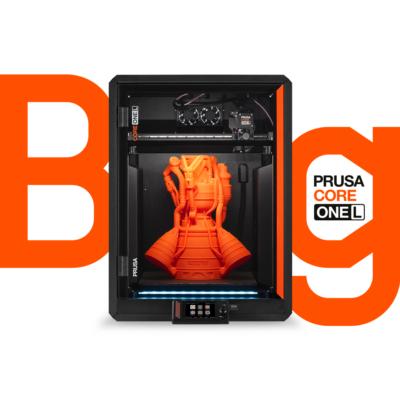
The Prusa CORE One L — 300 × 300 × 330 mm enclosed CoreXY printer. It is the benchmark for reliability in the large-format prosumer category. Image: Prusa.
What "Large Format" Actually Means
Before comparing machines, set expectations. We break large-format printers into three tiers:
| Tier | Build Volume | Price Range | Who It Is For |
|---|---|---|---|
| Enthusiast large format | 300 × 300 × 300 mm | $400–$1,200 | Makers, cosplay, functional parts |
| Prosumer large format | 350–500 mm cube | $800–$2,500 | Small businesses, service bureaus, engineers |
| Industrial large format | 500 mm+ on each axis | $10,000+ | Production, manufacturing, R&D |
There is no point buying a 500 mm printer if you only print 10 cm benchies. The extra frame size adds weight, setup time, and maintenance. Buy the smallest machine that can actually fit your largest expected part — plus 20% margin for brims and supports.
The Contenders
1. Prusa CORE One L — Best Overall Prosumer
Build volume: 300 × 300 × 330 mm
Price: ~$2,149 (machine only)
Max speed: 600 mm/s
Enclosure: Fully enclosed, 60°C chamber
Key feature: AC convection-heated bed, open-source firmware, Bondtech extruder
The CORE One L doubles the print volume of the original CORE One while adding only 10% to the physical footprint. The aluminum heat bed holds under 2°C variance across the plate, which essentially eliminates the warping that plagues ABS and ASA on budget machines. Prusa's reputation for reliability means this printer will run for weeks unattended — critical when a 30-hour print fails and you lose a day of production.
The trade-off: price. At $2,149, you are paying a premium for Prusa's engineering and support. If you need the 330 mm Z height for cosplay helmets or tall functional parts, it is worth it. If your parts fit in 250 mm, the standard CORE One at $1,299 is the better value.
2. Sovol SV08 Max — Best Value at 500 mm
Build volume: 500 × 500 × 500 mm
Price: ~$800–$900
Max speed: 700 mm/s
Enclosure: Open frame (DIY enclosure recommended)
Key feature: CoreXY, Klipper firmware, linear rails, four independent Z motors
The SV08 Max is the value play in true large format. A 500 mm cube at under $1,000 was unheard of three years ago. The CoreXY motion system, linear rails, and Klipper firmware give it real performance. At 700 mm/s top speed, it rivals machines twice the price.
The caveats matter. It is an open-frame printer, so printing ABS or ASA requires building or buying an enclosure. It arrives 90% assembled but needs calibration out of the box — belt tension, Z offset, and bed mesh are all on you. The print quality is excellent once dialed in, but this is not a plug-and-play machine like a Prusa or Bambu. If you enjoy tinkering and want maximum build volume per dollar, the SV08 Max is the clear choice.
3. Creality K1 Max — Best Enclosed Budget Option
Build volume: 300 × 300 × 300 mm
Price: ~$600–$720
Max speed: 600 mm/s
Enclosure: Fully enclosed (passive)
Key feature: AI LiDAR calibration, 300°C hotend, direct drive
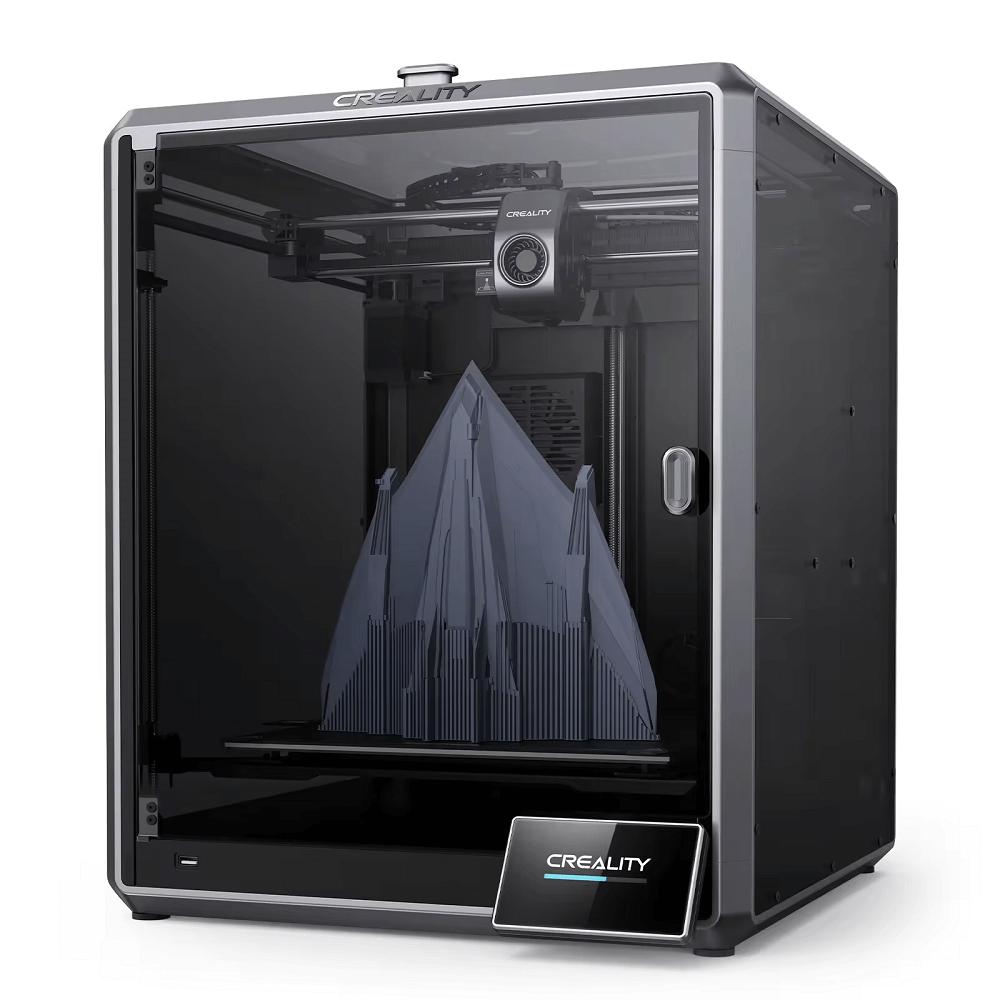
The Creality K1 Max — an enclosed 300 × 300 × 300 mm printer at under $700. The best entry point for enclosed large-format printing. Image: Creality.
The K1 Max sits in a sweet spot. It gives you an enclosed chamber, 300 mm cube volume, and 600 mm/s speed for under $700. The AI LiDAR auto-calibration handles bed leveling and first-layer correction, which saves hours compared to manual setup. The 300°C hotend opens up engineering materials like PC and blends.
The drawbacks are consistent with Creality at this price: build quality is good but not Prusa-level, the chamber is passively heated (not active), and long-term reliability over 2,000+ hours is mixed in user reports. For a first large-format printer or a secondary machine in a farm, it is excellent. For a business that needs 99% uptime, step up to the Prusa.
4. Bambu Lab H2D — Best Active Chamber for Multi-Material
Build volume: 300 × 300 × 300 mm
Price: ~$1,299 (with AMS)
Max speed: 500 mm/s
Enclosure: Active heated chamber up to 60°C
Key feature: Active chamber heating, AMS multi-color system, 24/7 monitoring
The H2D is not the biggest printer on this list, but it is the only one with active chamber heating at this price. For printing ABS, ASA, or PC without warping, that matters more than build volume. The AMS system handles up to 16 colors automatically. If your large-format prints involve engineering materials or multi-color parts, the H2D is the most practical choice.
The build volume is the limiting factor. At 300 mm cube, it competes with the K1 Max rather than the SV08 Max. But if "large format" for you means "printing ABS parts without an enclosure headache," the H2D wins on usability.
5. Sovol SV08 — Best Budget Tall-Z
Build volume: 350 × 350 × 400 mm
Price: ~$479–$599
Max speed: 700 mm/s
Enclosure: Open frame
Key feature: 400 mm Z height at under $500, Klipper, four Z motors
The SV08 is the smaller sibling of the SV08 Max. It trades width (350 vs 500 mm) for price ($479 vs $850). The standout spec is the 400 mm Z height — rare at any price point. If you print tall objects — leg armor, vases, lamp shades, vertical brackets — the extra Z space is more useful than a wider X-Y plate.
Same caveats as the SV08 Max: open frame, assembly required, Klipper setup. But at $479, it is the cheapest way into a CoreXY large-format machine.
6. Creality Sermoon M500 — Industrial Desktop
Build volume: 500 × 500 × 500 mm
Price: ~$12,000+
Enclosure: Fully enclosed, active chamber
Key feature: Industrial-grade frame, high-temperature hotend, production-ready
This is the step up from desktop. The Sermoon M500 is a true industrial machine — enclosed, actively heated, built for continuous production. At $12,000+, it is not a hobbyist purchase. But if you are running a service bureau and need 500 mm parts with enterprise reliability, it is worth comparing against used industrial systems that cost twice as much.
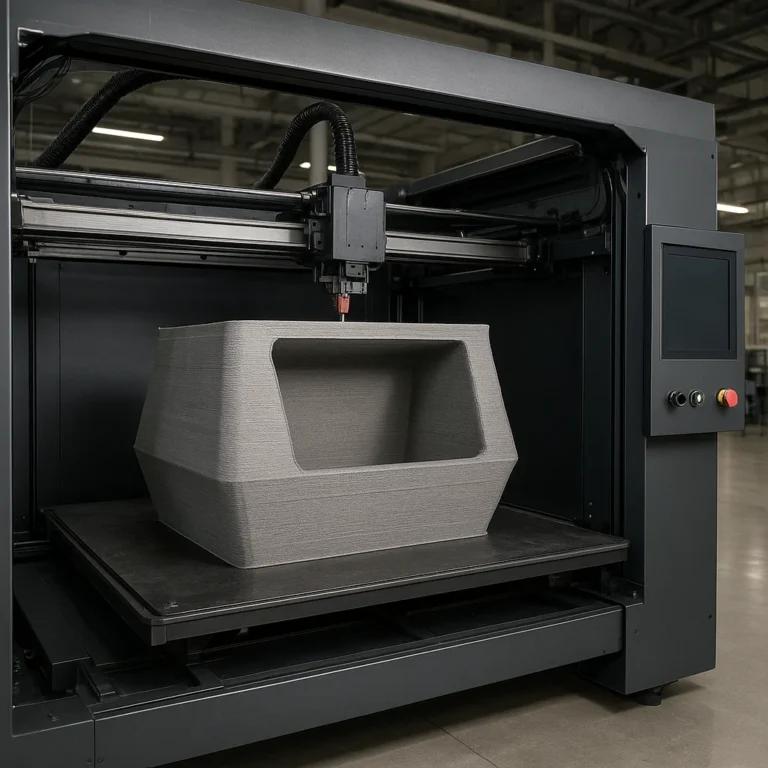
Industrial large-format printing. Machines at this tier (500 mm+ build volume, active chamber heating) are designed for production runs, not hobby printing. Image: industrial reference.
Quick Comparison Table
| Printer | Build Volume | Price | Speed | Enclosure | Best For |
|---|---|---|---|---|---|
| Prusa CORE One L | 300×300×330 mm | ~$2,149 | 600 mm/s | Active 60°C | Reliability, engineering materials |
| Sovol SV08 Max | 500×500×500 mm | ~$850 | 700 mm/s | Open frame | Maximum volume per dollar |
| Creality K1 Max | 300×300×300 mm | ~$650 | 600 mm/s | Passive | Best enclosed budget pick |
| Bambu H2D | 300×300×300 mm | ~$1,299 | 500 mm/s | Active 60°C | Multi-color, ABS/ASA |
| Sovol SV08 | 350×350×400 mm | ~$499 | 700 mm/s | Open frame | Tall prints, budget CoreXY |
| Creality Sermoon M500 | 500×500×500 mm | ~$12,000 | Industrial | Active | Production service bureaus |
What to Consider Before Buying
Do You Actually Need the Volume?
Measure your largest typical print. If it fits in 250 mm, do not buy a 500 mm printer. Large-format machines are heavier, louder, use more electricity, and take more floor space. The biggest regret we see from buyers is purchasing a 500 mm machine that spends 90% of its time printing 10 cm parts.
Enclosure Matters More Than Size
If you plan to print ABS, ASA, PC, or nylon, the enclosure is the single most important feature. An open-frame 500 mm printer printing PLA is fine. The same machine printing ABS will warp so badly you will want to throw it across the room. Either buy an enclosed printer (K1 Max, CORE One L, H2D) or budget $100–$300 for a DIY enclosure if you go open frame (SV08 series).
Print Time Scales Non-Linearly
A 500 mm print is not twice as long as a 250 mm print — it is up to eight times as long. The volume of a 500 mm cube is eight times that of a 250 mm cube. Before committing to a large-format machine, ask yourself: can I afford to leave a printer running for 40 hours? Do I have the electricity and the patience for failed prints that waste a day?
Bed Leveling on Large Plates Is Harder
A 300 mm PEI sheet flexes more than a 235 mm one. A 500 mm bed needs four Z motors (like the Sovol SV08 series) or active mesh leveling to stay flat. Automatic bed leveling is not optional on machines over 300 mm — it is required. Make sure whatever printer you buy has real-time mesh leveling, not just a single-point Z probe.
Who Should Buy What
| Your Situation | Recommended Printer |
|---|---|
| First large-format printer, budget under $700 | Creality K1 Max |
| Want 500 mm volume, enjoy DIY setup | Sovol SV08 Max |
| Need reliability for business, $2,000 budget | Prusa CORE One L |
| Multi-color ABS/ASA printing | Bambu H2D |
| Tall prints (400 mm Z), budget CoreXY | Sovol SV08 |
| Running a print farm, need 500 mm production | Creality Sermoon M500 |