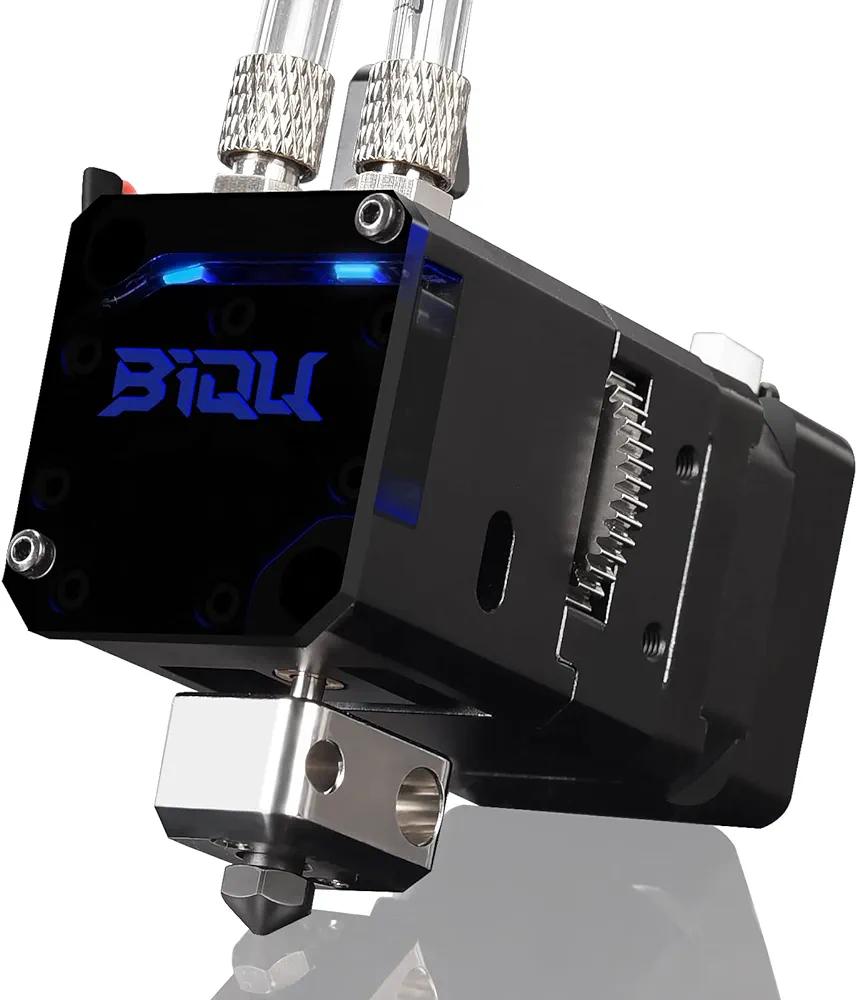
BIQU, part of the BIGTREETECH ecosystem, has built its reputation on upgrade components rather than complete printers. The H2 series of direct-drive extruders has become one of the most popular upgrade paths for Ender 3 and other budget printers, and the 2026 lineup — including the water-cooled H2O extruder — pushes the concept further with support for temperatures up to 500°C.
The H2O is the most interesting product in the lineup. It's a water-cooled version of the H2 V2.0 dual-gear extruder, designed for high-temperature printing with engineering materials like PEEK, PEI, and high-temp nylon. The water cooling keeps the extruder body and stepper motor at safe temperatures even when the nozzle is running at 500°C, which prevents heat creep and filament jamming that plague air-cooled extruders at extreme temperatures. BIQU sells a matching water cooling kit that integrates cleanly with the extruder design.
| Model | Cooling | Max Temp | Best For |
|---|---|---|---|
| H2 V2.0 | Air | ~300°C | General upgrade, PLA/PETG/TPU |
| H2 V2S | Air | ~300°C | Improved gearing, better extrusion |
| H2 V2S REVO | Air | ~300°C | RapidChange nozzle compatibility |
| H2 V2S Lite | Air | ~280°C | Budget option, lighter weight |
| H2O | Water | 500°C | PEEK/PEI/high-temp engineering |
Beyond extruders, BIQU's parent company BIGTREETECH dominates the aftermarket 3D printer control board market. The SKR series of 32-bit boards, TFT touchscreens, and Klipper-compatible hardware are used by thousands of makers to upgrade older printers. The BIQU BX printer, which integrates a BTT motherboard, OctoPrint, and the H2 extruder into one package, remains a popular choice for tinkerers who want a printer they can modify extensively.
BIQU is for makers who like to tinker. If you enjoy upgrading and modifying your printer rather than buying a closed-box solution, the H2 extruder series and BTT ecosystem offer some of the best upgrade components on the market. The H2 V2.0 is one of the cheapest ways to add a quality direct-drive extruder to an Ender 3, and it dramatically improves flexible filament printing.
The H2O is more niche — it's for people who specifically want to print high-temperature engineering materials. At 500°C, it opens up PEEK, PEI, and other materials that require extreme heat. But it requires a water cooling system, an enclosure, and a printer that can handle the thermal load. It's not a plug-and-play upgrade for beginners.