Creality K3 with KliTek: 4.8-Second Nozzle Swaps Shake Up Multicolor Printing
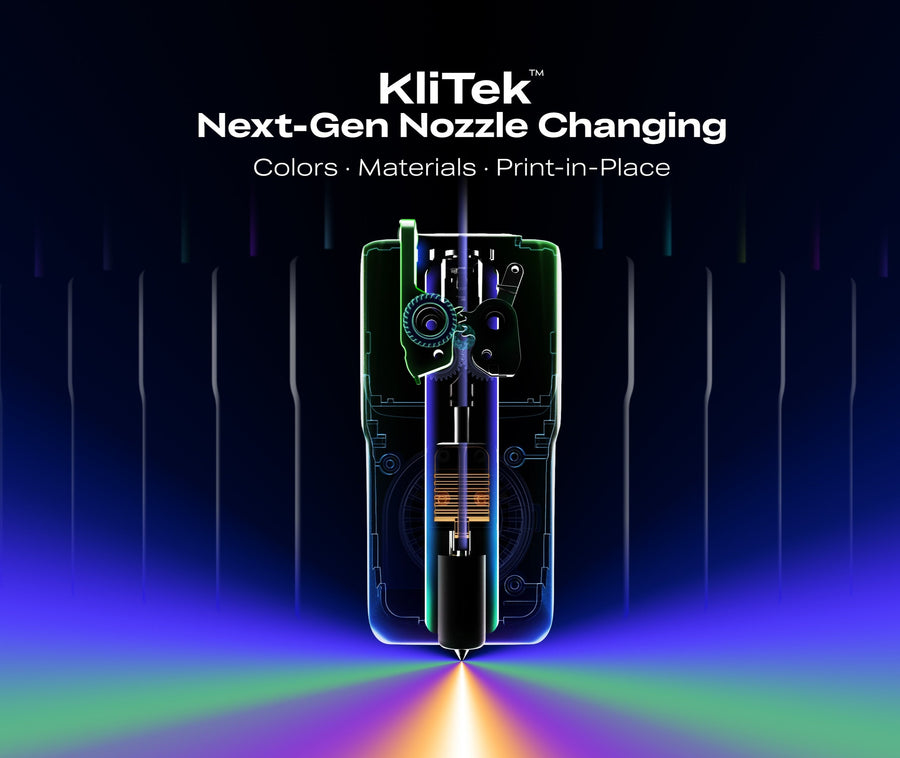
Creality used IFA 2026 in Berlin to pull the curtain back on the K3, its new flagship FDM printer, and the KliTek nozzle-changing system that powers it. The K3 won an IFA Innovation Awards 2026 Honoree designation, and the core claim is bold: swap nozzles in 4.8 seconds, no tools required.
If that sounds like a different approach to multicolor printing, it is. Instead of feeding multiple filaments through one nozzle and wasting material on purge towers, the K3 physically swaps the entire nozzle assembly. Each nozzle carries its own filament, its own color, and its own temperature profile.
How KliTek Actually Works
The KliTek system uses a multi-channel nozzle dock mounted on the printer frame. When the print calls for a color change, the print head moves to the dock, releases its current nozzle, picks up the next one, and resumes printing. The whole sequence takes about 4.8 seconds according to Creality's demo timing.
Because each nozzle is self-contained, there's no filament retraction, no cutting, and no purge block. The material that would normally be wasted on a purge tower — often 20-40% of a multi-color print — stays on the spool. For users who print a lot of multi-color figurines or decorative parts, that's a meaningful cost saving over time.
K3 Key Specs
| Spec | Creality K3 |
|---|---|
| Nozzle System | KliTek multi-channel, 4.8s swap |
| Colors | Up to 4 (one per nozzle) |
| Build Volume | 220 × 220 × 250 mm |
| Print Speed | Up to 600 mm/s |
| Hotend Temp | Up to 300°C |
| Feeder | S-Drive (TPU-optimized) |
| Firmware | Klipper |
| Availability | Q3 2026 |
The Rest of Creality's IFA Lineup
The K3 wasn't the only announcement. Creality also showed the SPARKX i8, a four-color printer positioned below the K3, and the SPARKX i7 Nano — a compact desktop four-color printer priced at $299. The M1 filament recycler, which turns failed prints and support material back into usable filament, also made an appearance.
Taken together, the lineup suggests Creality is serious about competing with Bambu Lab on multicolor printing at every price point — from the $299 i7 Nano up to the K3 flagship. The company also picked up two IFA Innovation Awards, one for the K3 and one for its broader ecosystem approach.
What to Watch For
The KliTek approach is clever, but it's unproven at scale. Nozzle docks can jam, alignment can drift over time, and swapping a hot nozzle assembly mechanically introduces wear points that a fixed-nozzle system doesn't have. Creality says the system is designed for thousands of swap cycles, but real-world reliability won't be clear until the K3 has been in users' hands for a few months.
Pricing hasn't been announced yet. If the K3 lands at $500-600, it's a serious alternative to the Bambu Lab A1 Combo. If it's closer to $800+, the value proposition gets harder to justify given Bambu's more mature ecosystem.