eSUN PLA-HF: The First Filament Rated for 1000mm/s High-Speed Printing
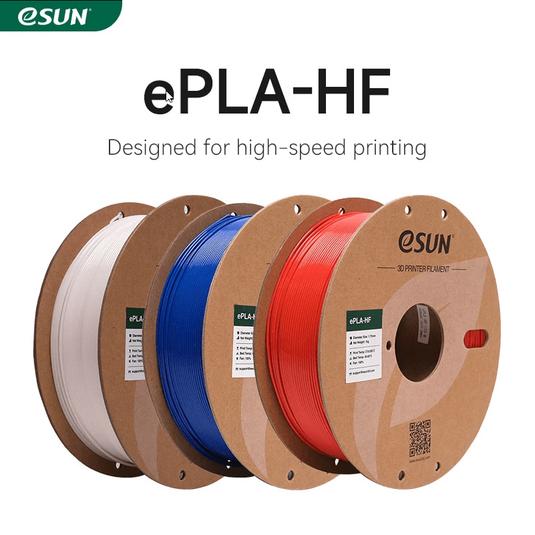
eSUN has officially released PLA-HF, a high-speed PLA filament that the company says can sustain print speeds beyond 1000mm/s on compatible machines. That's a significant jump from eSUN's earlier high-speed offerings — PLA-HS was rated for 300mm/s, and PLA+HS topped out around 350mm/s. PLA-HF roughly triples that ceiling.
The launch comes as high-speed FDM printers become mainstream. Bambu Lab's X1 and P1 series, Creality's K series, and ANYCUBIC's ACE line all push 500mm/s or more, but most standard PLA filaments can't keep up — they string, delaminate, or under-extrude at those speeds because the plastic doesn't melt fast enough in the hotend.
What Makes PLA-HF Different
The key is a modified polymer blend with faster melt flow characteristics. Standard PLA has a relatively narrow melting window — heat it too fast and it burns, heat it too slow and it doesn't fully liquefy before extrusion. PLA-HF uses a formulation that melts more quickly and more uniformly, which means the hotend can process more volume per second without degradation.
eSUN also says PLA-HF stays dimensionally stable up to 300°C hotend temperatures, which gives it headroom on machines that run hotends at 260-280°C for high-speed printing. Most standard PLA starts to degrade above 230-240°C.
Key Specs
| Spec | eSUN PLA-HF |
|---|---|
| Max Print Speed | 1000+ mm/s (claimed) |
| Hotend Temp Range | 190-300°C |
| Bed Temp | 50-70°C |
| Diameter | 1.75mm (±0.03mm) |
| Spool Weight | 1kg |
| Colors | Black, White, Grey, plus selected colors |
| Compatible Printers | Bambu Lab, Creality K-series, ANYCUBIC ACE, Prusa MK4 |
Real-World Performance
Independent testing on Bambu Lab X1 Carbon shows that PLA-HF can sustain 600-800mm/s on typical parts with acceptable quality, but hitting the full 1000mm/s requires a hardened steel nozzle, elevated hotend temperatures (260-280°C), and parts with relatively simple geometry. On overhangs and fine details, the quality drops off noticeably above 600mm/s.
That's not a criticism of PLA-HF specifically — it's true of any filament at extreme speeds. The point is that PLA-HF removes the filament as the bottleneck. If your printer can push 1000mm/s, PLA-HF can keep up. Whether the resulting print quality is acceptable depends on the part.
Is It Worth the Upgrade
If you're printing on a standard Ender-3 or Prusa Mini at 50-80mm/s, PLA-HF is overkill. Regular PLA will give you the same results at a lower price. PLA-HF makes sense if you own a high-speed printer and you're currently frustrated by stringing or under-extrusion when you crank up the speed.
It's also worth noting that eSUN has been aggressive on pricing. PLA-HF launched at a price point close to premium PLA, not the "specialty filament" premium that some brands charge for high-speed materials. That makes it a low-risk upgrade if you're curious.