Formnext Asia Shenzhen wrapped up its biggest edition yet on August 28 at the Shenzhen World Exhibition & Convention Center. Three hundred thirty exhibitors across 20,000 square meters, more than 27,000 visitors. After walking the floor for three days, one thing was clear: this industry isn't arguing about whether 3D printing works anymore. It's fighting over who can turn it into a real business.
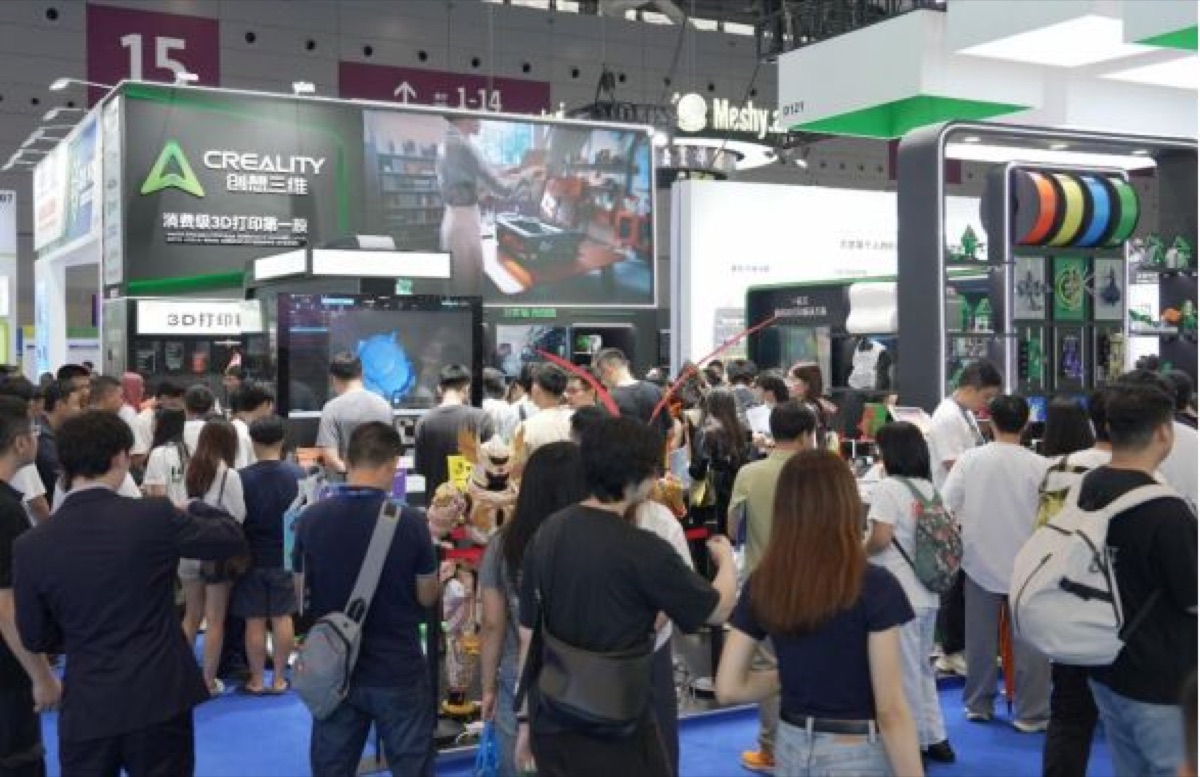
New Machines: Consumer Brands Fight Over Multi-Nozzle, Industrial Goes All-In on Green-Laser Copper
The biggest consumer launch was Creality's K3, making its first public appearance. It runs the KliTek multi-nozzle platform the company announced back in May, and the pitch is straightforward: no more slow filament swaps, no more wasted purge material. Multiple nozzles work together so multi-color, multi-material prints finish in one pass. Creality also brought the Ender-3 V3 Mega, SPARKX i7 resin printer, HALOT-X1 Max, the Pika portable model, and the M1/R1 filament recycling system — basically the entire "print to recycle" pipeline on one booth.
Bambu Lab didn't launch a new printer, but their D121 booth ran the H2D, X2D, and P2S side by side, pushing carbon-fiber engineering filaments and tooling-free rapid prototyping. The specs they quoted are aggressive: 1000 mm/s toolhead speed, multi-sensor auto-calibration pushing print success rate to 98%. The more interesting signal was the talk their application engineer gave at the co-located Print Farm conference — titled "From Creative Tool to 10,000-Machine Farms." Translation: the next growth wave for consumer printers isn't selling to more hobbyists. It's selling to more print farms.
Over on the industrial side, green-laser copper printing owned the spotlight. Hans Laser (Dazu Juwei) used day one to launch the HANS M420G green-laser metal printer. It runs a 532nm green laser that pushes pure copper absorption from under 5% (with infrared) to roughly 40%, with a 40μm spot size fine enough for thin walls, micro-holes, and complex internal channels. Dual- or quad-laser configurations are available. The target market is AI thermal management and low-altitude economy.
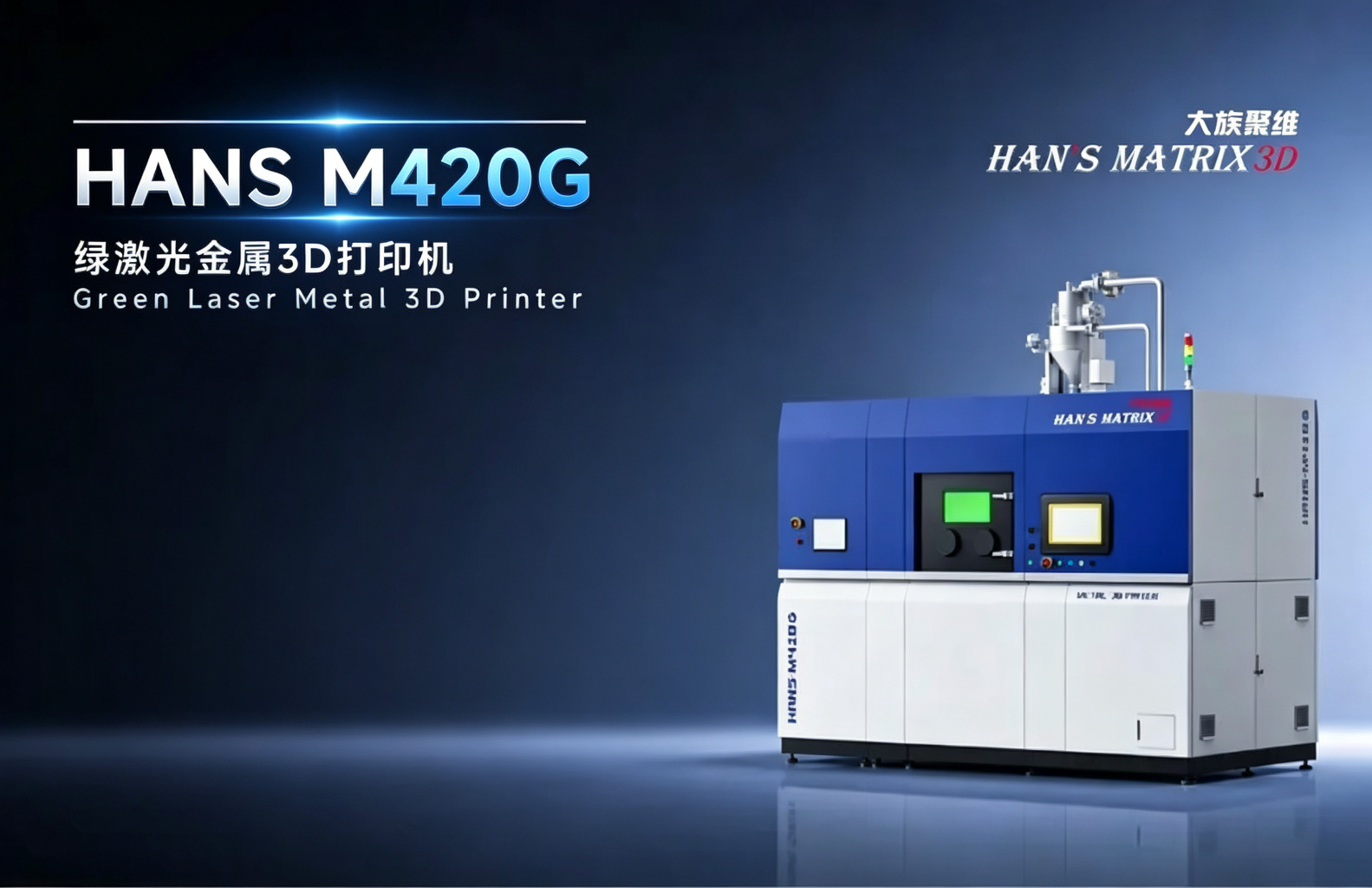
| Feature | Specification |
|---|---|
| Laser Type | 532nm green laser (vs. ~1064nm infrared) |
| Copper Absorption | ~40% (vs. under 5% with infrared lasers) |
| Laser Spot Size | 40μm — fine enough for thin walls, micro-holes, and complex internal channels |
| Laser Configuration | Dual-laser or quad-laser options available |
| Target Materials | Pure copper and high-reflectivity metals |
| Key Applications | AI server thermal management (cold plates), power electronics, low-altitude economy components |
| Design Focus | Batch production of highly reflective materials with stable continuous printing |
| Optical Path | New external optical path design for enhanced optical stability |
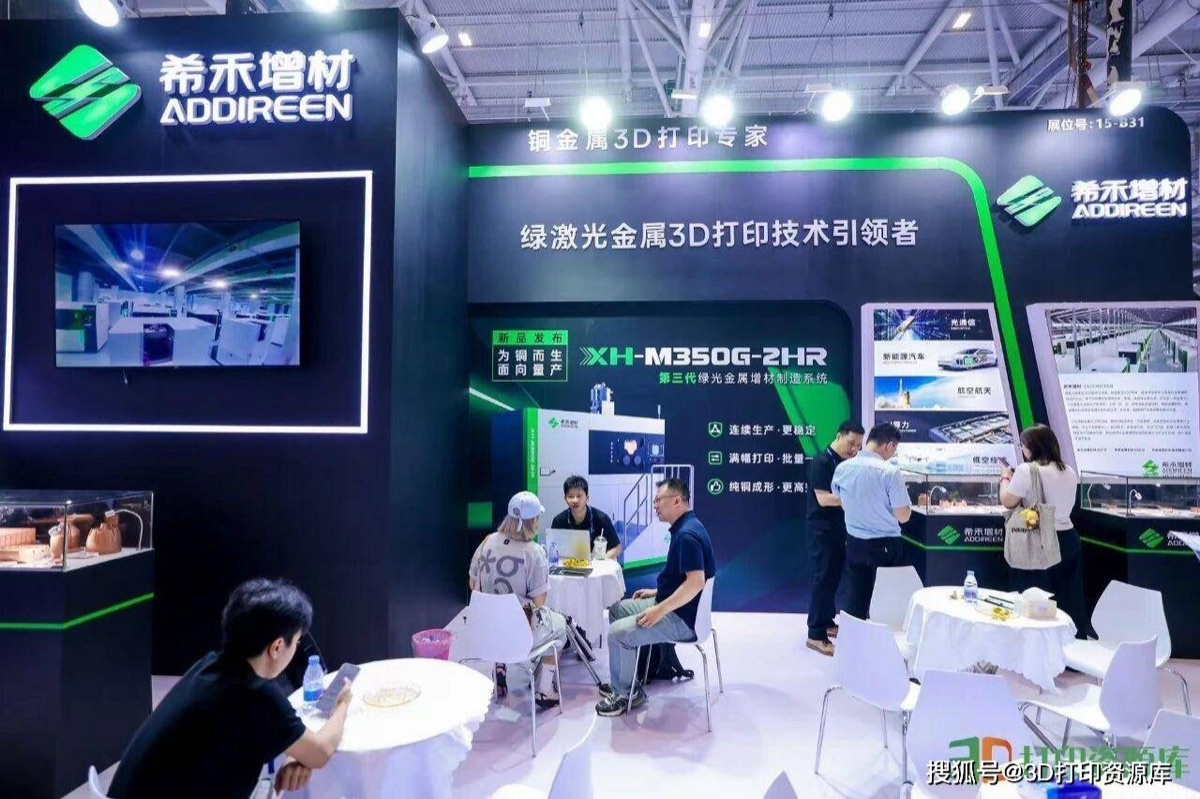
Xihe Additive (Addireen) dropped the XH-M350G-2HR, a dual-green-laser system built for batch production of copper parts. Kings3D subsidiary Laseradd showed the DiMetal-300G, a 500W single-mode green-laser system for pure copper and copper alloys. When one company does green-laser copper, it's an experiment. When three do it in the same show, it's a category.
Two other machines worth noting: HP brought the compact MJF 1200 — a 12-liter build volume system that packs industrial Multi Jet Fusion into something an engineering team can actually fit in an office. And Makera showed up at a 3D printing show with desktop five-axis CNC machines. The line between additive and subtractive is blurring fast. Customers don't care which one you use — they want the shortest reliable path from a CAD file to a working part.
New Materials: Flexible, Child-Safe, and Actually Functional
The material aisle was as busy as the equipment floor. Three trends stood out.
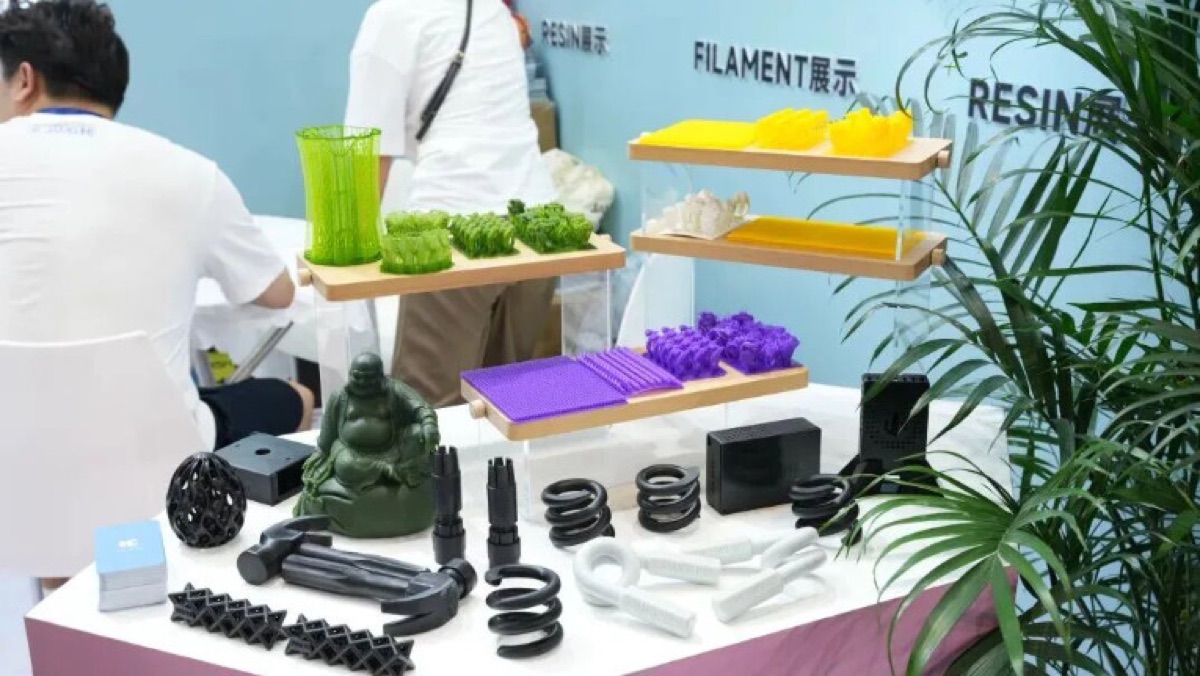
Flexible materials are getting skin-friendly. Shengjialun Rubber & Plastic showed a self-developed pure TPE filament that they describe as "bouncy and skin-friendly, close to silicone or baby pacifier texture." Target applications are medical, footwear, and protective gear. They also launched Sun Dots, a filament brand specifically for kids, focused on non-toxic safety. First dedicated children's filament brand — tells you how granular the consumer market is getting.
Standard filaments are getting "2.0" upgrades. SUNLU rolled out PLA+ Silk 2.0 (brighter finish, better layer adhesion so it doesn't snap), PP 2.0, PETG 2.0, plus FGF pellet material. Nothing revolutionary, but it signals the filament market has moved past "does it exist?" into "is it good enough to sell?"
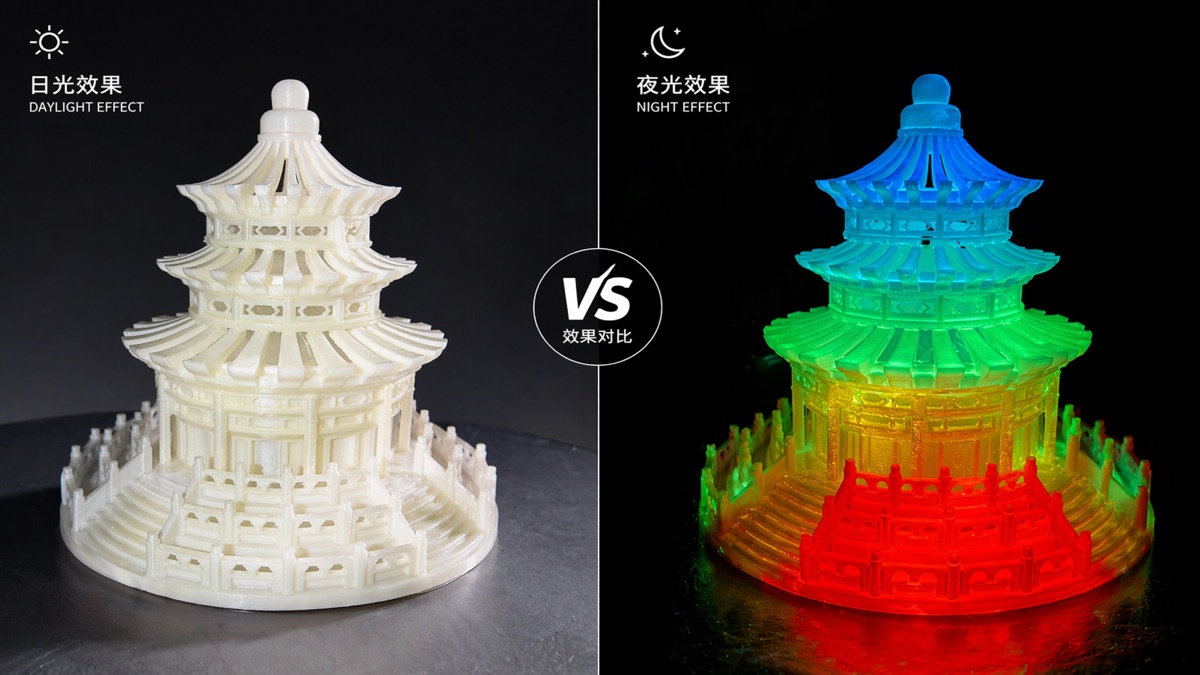
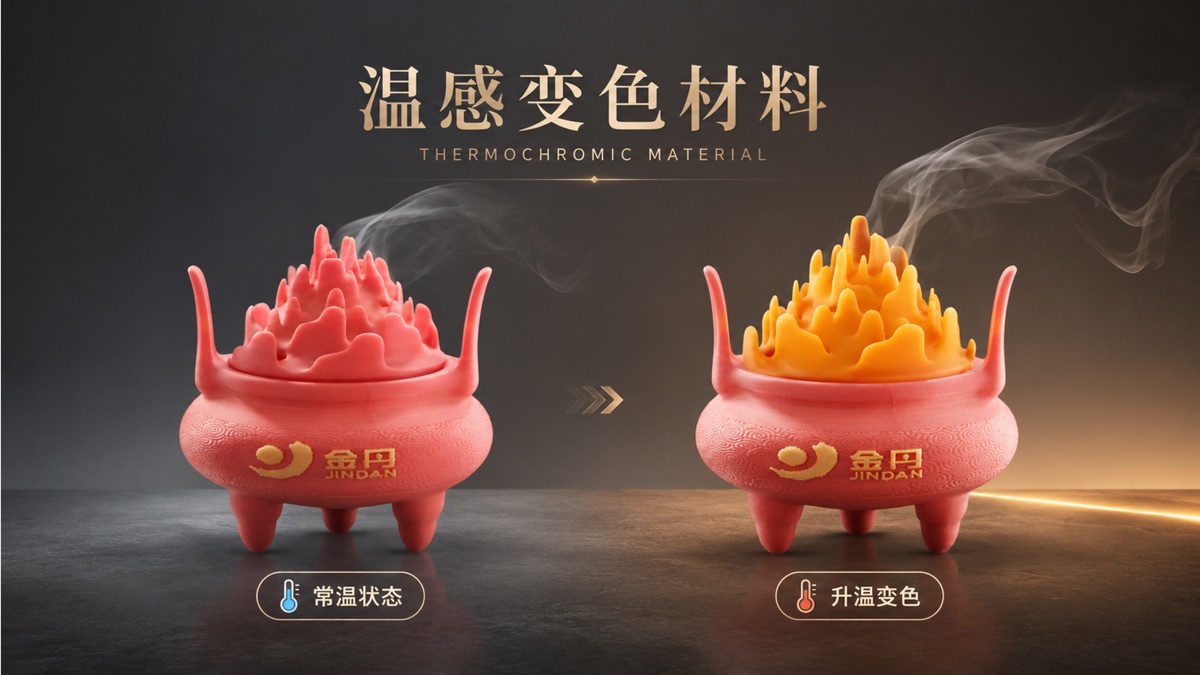
Functional materials are starting to tell a story. Yuyuan New Materials had one of the most visually striking booths: self-luminous filament (charges in light, glows in the dark) and thermochromic filament (changes color when heated). They demonstrated it with Temple of Heaven and boshan furnace models — clever choice, because the incense burner actually heats up and changes color in real time. Still mostly for creative and education markets, but the direction is right: 3D printed parts shouldn't just be shapes. They should do something.
On the metal powder side, Zhongti Xincai launched CNPC-Cu high-purity copper powder (≥99.95% purity, aimed at 3.2T high-speed optical modules and supercomputing liquid-cooled housings), plus CuCrZr and CuCrNb aerospace-grade copper alloys. Wilary showed GH3625/GH4169/GH4099 superalloy powders and TC4 titanium. The copper powder and green-laser equipment launches are paired — one side solves "can we print copper," the other solves "what copper do we print."
Six Signals Worth Paying Attention To
1. AI Cooling Is the Biggest New Market for Industrial AM
High-density AI server chips are pushing past what air cooling can handle, and 3D printing can make internal channels and conformal heat sinks that traditional machining can't. Addireen's booth had copper cold plates for GPUs, CPUs, memory modules, optical modules, and automotive power electronics — they said their AI server and IGBT cooling products are already in batch production. Multiple green-laser copper vendors entering at the same show suggests this demand isn't just slide-deck material.
That said, 3DPrint.com's floor report raised a fair point: "Multiple suppliers making copper cold plates doesn't prove AI cooling is a big AM market. It proves multiple companies believe it could be." What matters next is repeat orders and qualified part numbers, not more cold plates on exhibition tables.
2. Print Farms Are a Real Business Now
At the co-located Print Farm conference, industry estimates put roughly 390,000 printers running in Chinese farms as of August 2026 — about 350,000 of them Bambu Lab machines. More than 40 farms have 1,000+ machines. The cost number that matters: setting up a 1,000-machine farm dropped from about 5 million RMB in 2024 to roughly 1 million RMB in 2026. Large orders are being quoted below 0.1 RMB per gram.
That's production infrastructure. It's also an early commodity market — machine capacity is growing faster than demand, prices are falling, and the window where a new product stays differentiated is measured in days.
3. AI Modeling Is Solving the Content Bottleneck
Meshy AI's demo was straightforward: take a photo of a visitor's face, and a few minutes later you get a stylized 3D character that still looks recognizably like them. The pipeline includes style selection, editing, mesh checking, auto-repair, and export to printable STL or 3MF. The underlying shift: when printers get cheaper and easier, the bottleneck moves upstream. Users need ideas, differentiated content, and models that survive the jump from a nice render to a printable object. AI can boost printer utilization by making that jump easier — but it also means competitors can generate similar products just as fast.
4. Footwear: Lots of Hype, Not Much on Feet
The show launched a dedicated footwear design award that drew 100+ submissions. Booths displayed printed midsoles, complete shoes, elastomer systems, foot scanners, lattice design software, and cloud production platforms. PollyPolymer is positioning the same elastomer material for both footwear and compliant robotic components.
But here's the thing: outside the hall, nobody was wearing directly 3D-printed shoes. That's anecdotal, but it captures the gap between supplier enthusiasm and actual consumer adoption. A shoe can clearly be printed. The question is what market that creates — genuinely personalized footwear, or just another way to mass-produce shoes with slightly different shapes? Printed shoe molds, by contrast, are already mature — they improve an existing category with established distribution and quality standards, no consumer education required.
5. Humanoid Robots and Drones Are Default Customers Now
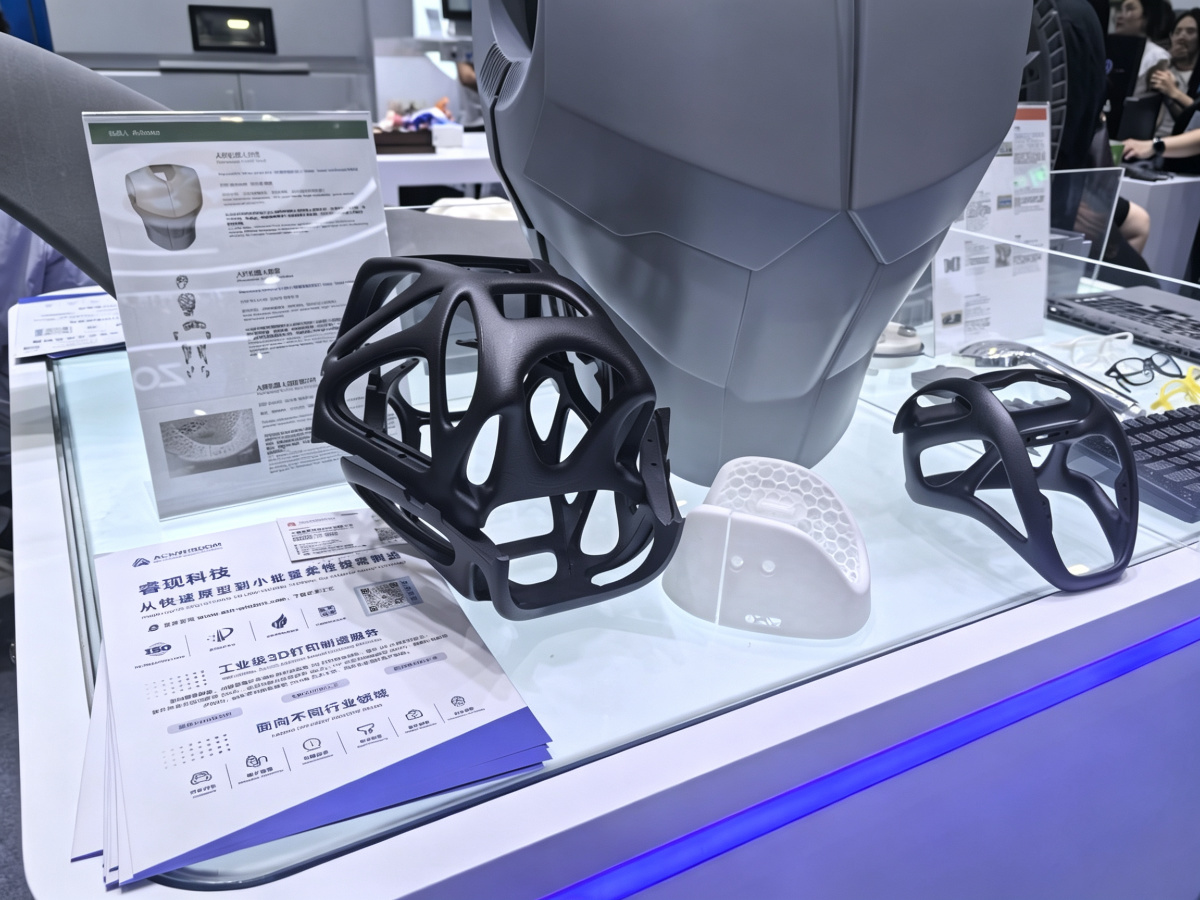
Ruixian Technology's booth showed humanoid robot housings, structural parts, and compliant components, all aimed at shortening R&D cycles. Bambu Lab's high-speed FDM line is being pitched for drone frames, gimbal guards, and quick-release parts. The two hottest sectors of 2026 — low-altitude economy and humanoid robotics — both treat 3D printing as the default option for prototyping and small-batch production.
6. Full Supply Chain Localization Cuts Both Ways
Something deeper was visible below the complete-machine level. Chinese suppliers now make scanners, laser sources, scan heads, optics, motion control, monitoring systems, industrial CT, powder screening, powder extraction, power supplies, and filament production lines. A pre-show count found 44 AM-adjacent equipment companies — more than six times the standalone software cluster.
That's more significant than just replacing an imported printer with a domestic one. A local machine builder can source and modify more of the system nearby. A service provider can combine printing with scanning, CNC, inspection, and finishing. When a new opportunity appears, the necessary suppliers can respond fast. But low coordination cost also means low imitation cost. Once footwear, humanoid robots, AI cooling, or consumer figures get identified as promising, a lot of companies move in the same direction at the same time. The most striking thing on the floor wasn't any single invention — it was how quickly similar offerings pile up.
The Bottom Line
The core message from this year's Formnext Shenzhen: China has already built the full additive manufacturing stack. The harder question is whether end-market demand can keep up with the speed of supply.
On the consumer side, farmification and price drops are accelerating, but product differentiation windows are shrinking. On the industrial side, green-laser copper and AI cooling are the most convincing directions — but they still need to move from "cold plates on a booth" to "repeat orders on a production line." Materials and software are filling gaps, but nobody's found a true killer app yet.
Or as 3DPrint.com's Simon Lee put it after walking the floor: "The region can assemble the stack faster than most markets. The harder test is whether end-market demand can turn that speed into durable businesses."
Sources: 3DPrint.com — Formnext Asia Shenzhen 2026: China Has Built the AM Stack | Sina Finance / Leiphone — Creality K3 first public appearance | NetEase — Hans Laser HANS M420G green-laser metal printer launch | Powdersight — Green-Laser Copper Printing Surges | Shenzhen Evening News — New materials and AI modeling activate AM industry | Smzdm — Formnext Shenzhen 2026 eight key highlights | Sohu — Xihe Additive XH-M350G-2HR launch | NetEase — Bambu Lab "From Creative Tool to 10,000-Machine Farms" talk