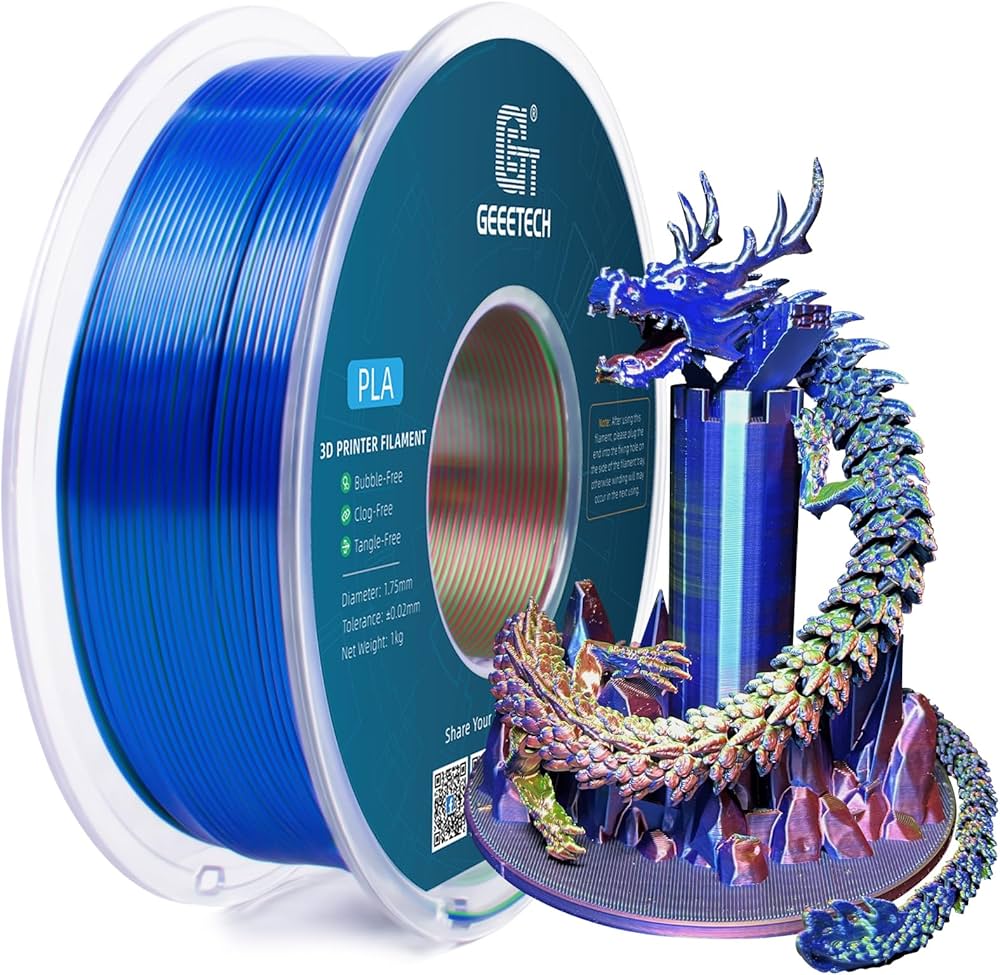
GEEETECH has been around since the early days of consumer 3D printing, and while the brand isn't as flashy as Bambu Lab or Creality, it's quietly built a solid lineup of special-effect filaments and budget multicolor printers. The 2026 filament range leans heavily into silk and multicolor effects — tri-color silk PLA, rainbow PLA, and macaron gradient silk — at prices that undercut most competitors.
The tri-color silk PLA is the standout. Three colors are extruded into a single strand, so as the filament rotates through the nozzle, the printed part shifts between hues automatically. No AMS or MMU required. The silk finish adds a metallic sheen that makes the color transitions look more dramatic than standard matte multicolor filaments. GEEETECH also offers a rainbow version that cycles through more colors, and a macaron gradient line with softer pastel transitions.
| Product | Category | Key Feature |
|---|---|---|
| Silk Tri-Color PLA | Filament | 3 colors in one strand, silk finish |
| Rainbow PLA | Filament | Multi-color gradient, 1kg spool |
| Macaron Gradient Silk | Filament | Soft pastel transitions, silk texture |
| Pure PETG 2kg | Filament | Vacuum packaging, bulk value |
| A10M | Printer | Dual extruder multicolor, 220x260mm |
| M1 Mini | Printer | Compact desktop, beginner-friendly |
On the printer side, the A10M remains GEEETECH's signature machine — a budget dual-extruder printer that can print two colors simultaneously or mix them for gradient effects. It's not as polished as modern CoreXY machines, but at under $300 it's one of the cheapest ways to get into multicolor printing without an AMS system. The M1 Mini is a smaller, simpler machine aimed at beginners and educational use.
GEEETECH's sweet spot is decorative and artistic printing. If you want to print dragons, figurines, cosplay pieces, or display models with eye-catching color effects, their silk and rainbow filaments deliver good results at budget prices. The tri-color silk PLA in particular produces prints that look more expensive than the filament costs.
The trade-off is consistency and quality control. GEEETECH filaments have more batch-to-batch variation than premium brands, and the silk finish can be tricky to dial in on some printers. Tolerance is rated at ±0.03mm, which is acceptable but not class-leading. For functional parts or engineering prototypes, look elsewhere. For decorative prints where color and finish matter more than precision, GEEETECH is a solid value.