Hi3D Agent Puts an AI Copilot at the Start of the 3D Printing Workflow
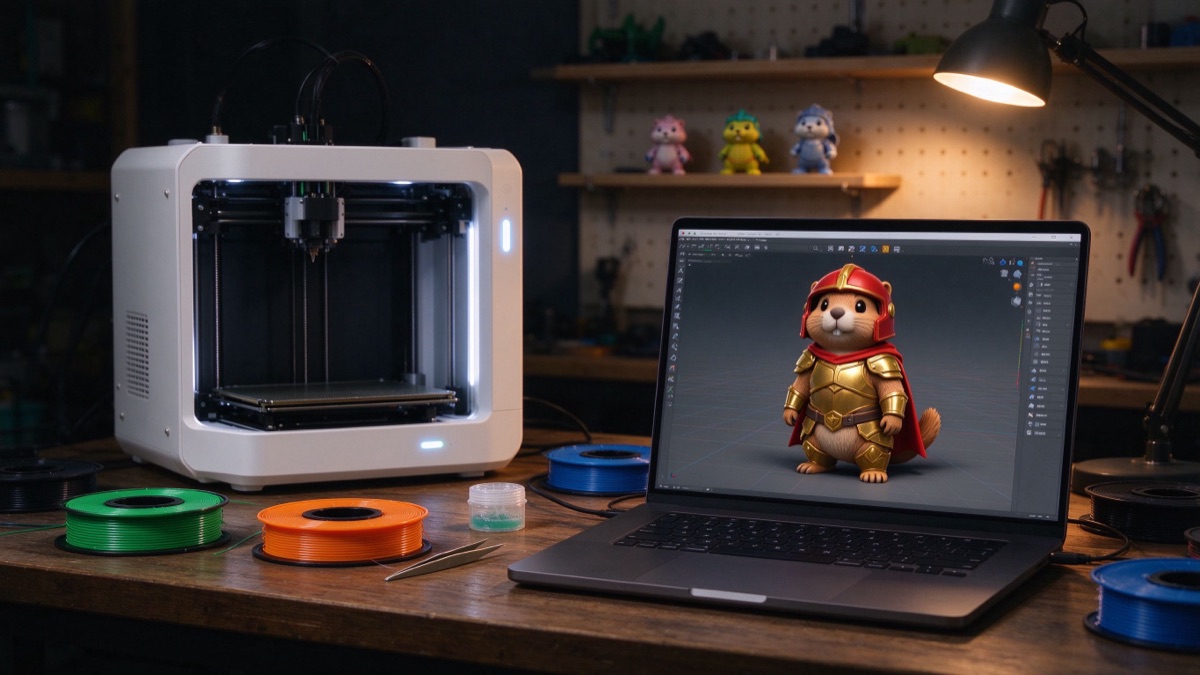
The model, not the printer, has been the bottleneck. Hi3D Agent is aimed directly at that first step.
The funny thing about the 3D printing workflow in 2026 is that the printer stopped being the bottleneck years ago. The bottleneck is everything before it: the model. If you can't get a good model file, that machine in the corner is just an expensive paperweight. Most of us who own one have spent more nights fixing broken meshes than we have printing anything.
Hi3D is betting that the fix belongs at the very start of that workflow. On September 21, the company launched Hi3D Agent, which it calls the world's first all-in-one AI agent purpose-built for 3D creation. Instead of another image-to-3D tool that hands you a mesh and says "good luck," the agent tries to walk you from a rough idea all the way to a print-ready file inside a single conversation.
I spent an afternoon digging through the launch material and the reporting around it. Here's what's actually worth knowing, and what it means if you run a small print business or just print for fun.
What Hi3D Agent actually is
The agent splits the work between two very different kinds of AI. A large language model handles the reasoning: it reads what you ask for, decides which steps to run, and calls the right tools. Hi3D's own 3D model handles the geometry, which is exactly the part where general-purpose LLMs still fall flat. You can ask a chatbot to describe a ceramic squirrel, but you can't ask it to produce a watertight mesh.
Hi3D says the agent runs on Hi3D V3.0, which it describes as the first commercially available AI 3D model to generate at 2048³ voxel-level resolution. The marketing language is "high-fidelity geometry, strong structural consistency, and high-quality textures," which is worth taking with a grain of salt until people actually print the output, but the direction is clear. The company positions the model as especially good at organic, visually complex shapes — characters, animals, natural forms — the stuff that's miserable to build in CAD and takes forever to sculpt by hand.
The other part is workflow. Instead of jumping between a generator, a texturing tool, a mesh repair utility, and a slicer, you stay in one conversation. The agent can pull in external tools and reusable skills as it goes. For someone who has never touched Blender, that removes most of the "what do I do with this file now" problem in one move.
Why the start of the workflow is where AI matters most
Everyone keeps talking about AI agents in manufacturing, but most of the attention has landed on the engineering side: fixing files, preparing builds, optimizing toolpaths. Synera, for example, has been pushing AI agents for additive manufacturing engineering teams, aimed at the hours engineers spend repairing files and iterating on designs. Carnegie Mellon researchers even demonstrated LLM-Drone, where language models direct aerial robots that assemble structures from blocks — 90 percent build accuracy in lab tests, with the LLM revising plans mid-flight.
Those are real, and they matter. But they all assume you already have a model. Hi3D Agent sits one step earlier, at the point where most hobbyists and small studios actually get stuck: turning an idea into a first model at all. That's a different problem, and it's the one the industry has mostly ignored because it was too messy to automate. Organic shapes, inconsistent reference images, "I want a cute robot that holds a coffee cup" — that's a language problem plus a geometry problem, which is exactly what an LLM paired with a 3D model is built to attempt.
The tools built for people who actually print
The agent itself is the headline, but the platform around it is where the print-focused features live, and several of them are aimed squarely at getting a file onto a build plate.
Split for 3D Printing takes a large or complex model and divides it into printable parts, adding connectors so they can be assembled after printing. This is the feature that fixes the two classic failures of big prints: objects that exceed the build volume, and models that would need heavy, scarring supports. On a 220mm plate, being able to split a 400mm model into interlocking pieces changes what you can even attempt.
Multicolor 3D Printing converts a textured model into color regions that a multicolor printer can actually reproduce. This one matters more than it sounds. AI-generated models come with textures baked in, but a texture isn't a print plan. Turning that digital color into mapped regions that Bambu Studio or OrcaSlicer can feed to an AMS-style system is the step that usually takes people an evening of fiddling. Hi3D is trying to make it automatic.
The wider platform rounds out the pipeline: Image to 3D Model for the core generation, AI Texturing for untextured meshes, and 3D Model Maker, which bundles image-to-3D, texturing, splitting, and multi-format export into one interface. Export covers the usual suspects — STL, OBJ, GLB, FBX — and one-click send to Bambu Studio, OrcaSlicer, Creality Print, and similar slicers. Hi3D claims a usable model in about two minutes from upload, and says it's trusted by more than 1,000 makers and small business owners. Two minutes is optimistic for anything complex, but the direction of travel is right.
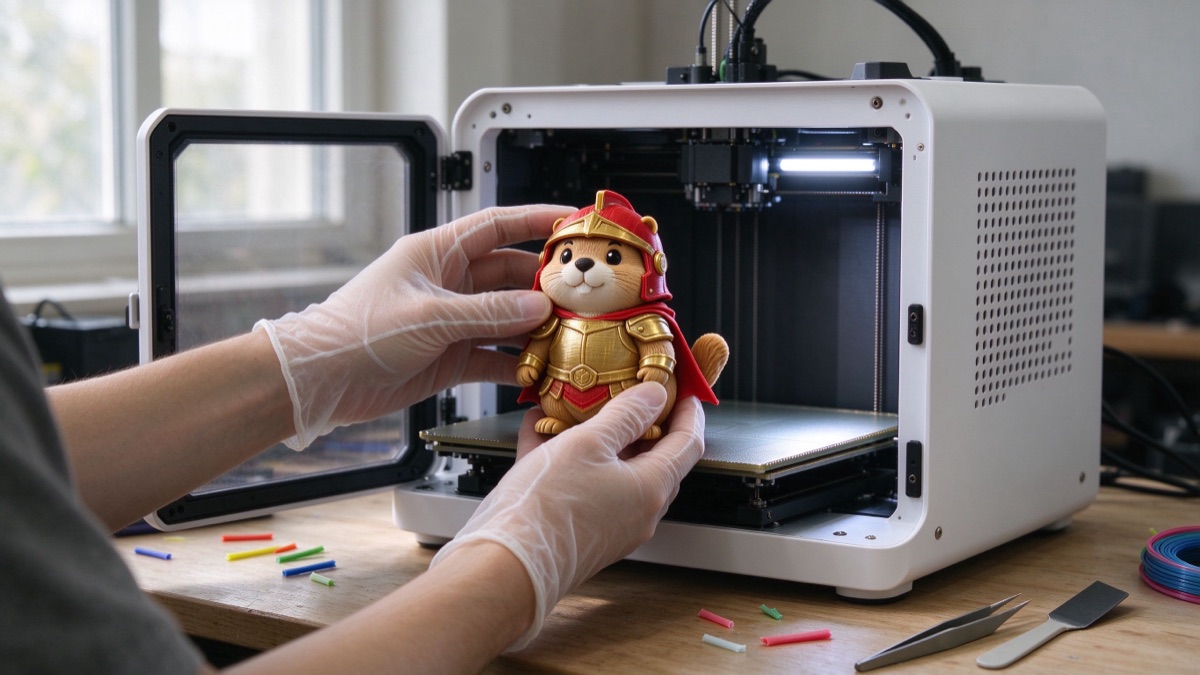
The output still has to survive slicing and printing. That's the part to watch.
Who wins if this catches on
The clearest beneficiaries are the people making small, organic, character-driven products. Figurine sellers on Etsy, miniature painters, prop makers, people who turn a child's drawing into a toy — that's exactly the category where manual modeling costs the most and AI generation helps the most. A $2,000 printer and a weekend of mesh repair was a high wall; now the wall is mostly gone.
For small studios, the shift is more subtle but probably bigger. A client shows up with a reference image and wants a prototype in a week. The old workflow means finding a modeler, waiting, and paying for sculpting time. With an agent-based pipeline, the first usable model exists in an afternoon. It won't be production-grade, but a starting point that fast changes how you quote jobs and how many jobs you can take.
That's also why Hi3D is running a Creator Rewards Initiative alongside the launch, from September 21 to October 21, with membership and credit rewards distributed through its official X account. The mechanic is the same one every AI company uses these days: get creators in early, let them generate content, and let that content do the marketing. Whether the rewards are worth anyone's time is a question nobody can answer until the campaign ends, but the intent is obvious.
The honest caveats
Let me be straight about the parts that should make you skeptical.
First, all the impressive numbers are Hi3D's own. "World's first," "2048³ voxel resolution," "high-fidelity," "1000+ users" — these are marketing claims from the launch materials, not independently verified benchmarks. The real test is what the output looks like after slicing, and that data simply doesn't exist yet because the agent is weeks old.
Second, the strength is organic geometry, and that's also the weakness. If you're designing a functional bracket, a hinge, or anything with precise dimensions and tolerances, an AI generator is the wrong tool and probably always will be. Nobody should be asking an agent for a press-fit part with a 0.1mm tolerance. The pitch is for characters, collectibles, props, and prototypes — the fuzzy end of the design space.
Third, IP is the quiet problem nobody in the launch material mentions. An agent that generates characters from descriptions is going to produce things that look like existing IP, whether it intends to or not. If you're selling the output, "the AI made it" is not a defense against a copyright claim. Anyone building a business on generated figurines needs to think about this before they list the first product.
And fourth, a conversation-style agent is only as good as its error recovery. LLMs are good at planning and bad at precision. When the generated mesh has a hole or a non-manifold edge, the question is whether the agent catches it and fixes it, or whether you still end up in MeshMixer at midnight anyway. The launch material talks about printability checks and auto-repair, but that's exactly the kind of promise that only shows its real quality after a few hundred users stress it.
The bigger picture
The pattern across the industry this year is that agents are moving into every stage of additive manufacturing, from different directions. OpenAI's GPT-6 Astra can reconstruct CAD geometry from photos, which matters for reverse engineering. Synera's agents handle the engineering middle: file repair, build prep, iteration. CMU's LLM-Drone covers fabrication itself. Hi3D is claiming the front door — the moment of creation, where most users start and where most tools have refused to help.
If those front-door agents work even half as well as the marketing suggests, the economics of small-scale 3D production shift in a real way. The cost of a first model drops from "a few hundred dollars and a week" to "an afternoon and a subscription." That doesn't kill professional modelers any more than slicing software killed printer technicians. But it changes who can participate, and it changes the entry price of the hobby and the business alike.
Bottom line
Hi3D Agent is worth trying if you've ever been blocked at the "I have an idea but no model" stage, which is most of us. The platform runs in a browser, so you can push a test model through the pipeline in an afternoon without installing anything, and the tools around it — splitting, multicolor conversion, slicer integration — are genuinely aimed at people who print, not just people who render pretty pictures.
Just keep the caveats in the back of your head: the numbers are the company's, the organic shapes are the strength, and the IP question is yours to solve, not theirs. I'll be more interested in what the output looks like on a build plate in a few months than in anything the launch page claims today.