Adapted from Nanjixiong 3D Printing Network (Antarctic Bear) · August 21, 2026
Bambu Lab already holds more than 40% of the global consumer 3D printer market. Its revenue passed RMB 10 billion in 2025 and may top RMB 20 billion this year. Instead of simply defending that one category, the company is doing something that looks obvious in hindsight: selling the same maker customers a laser engraver, a 3D scanner, and soon a UV printer. A full portfolio of personal-manufacturing tools is now its core strategy.
From One Breakout Product to a Full Tool Lineup
Bambu's printer lineup already spans the market: the entry-level A1 mini and A1, the mid-range P1S and P2S, and the X series plus the flagship H series — covering prices from roughly RMB 1,000 to nearly RMB 10,000. That range carried the company past RMB 10 billion in 2025 revenue, No. 1 in the global industry.
A company this size can't ride a single product forever, and the customer overlap makes its next moves easy to guess. Someone who prints, DIYs, and builds things at home is also a likely buyer for laser work, UV printing, 3D scanning — and, one day, a desktop CNC.
The expansion is already on the public record:
- March 2025 — the H2D ships with a built-in laser module, a first test of the waters.
- January 2026 — framework agreement signed with Scantech to enter consumer 3D scanning.
- August 2026 — the R1 laser machine is officially teased for a September launch.
- August 2026 — the consumer UV printer project kicks off, with the first engineering jobs posted.
Three technology tracks — 3D printing, laser processing, and UV printing — now move forward in parallel.
UV Printing: Shrinking Industrial-Grade Hardware onto a Desktop
Traditional UV printers are bulky, often cost several hundred thousand RMB, and require trained operators, which has kept them locked inside signage, packaging, and industrial print shops. Desktop UV is the breakout hardware category of 2025–2026: Anker's eufyMake E1 pulled in more than $42 million on Kickstarter, a platform record, and xTool's O1 topped RMB 100 million in sales on its first day.
Bambu is solving the same problem it cracked in 3D printing: squeeze industrial performance into a desktop machine, use software and a closed ecosystem to flatten the learning curve, and make a pros-only tool work out of the box for ordinary users. Its postings target veteran engineers with Epson, Ricoh, and Xaar printhead experience and a track record mass-producing inkjet equipment. More than a dozen roles cover printhead drive electronics, waveform and ink-path design, material validation, and software integration. Motion compensation and machine control, already mature in its printers, carry over even though UV printing forms images in a completely different way.
The Laser Team Is Already Over 100 People
Laser processing is Bambu's first real step outside its home turf. Multiple industry sources say the project was formally chartered at the end of 2025 under a standalone, deliberately young team, hired mostly from outside and scaled past 100 people this year.
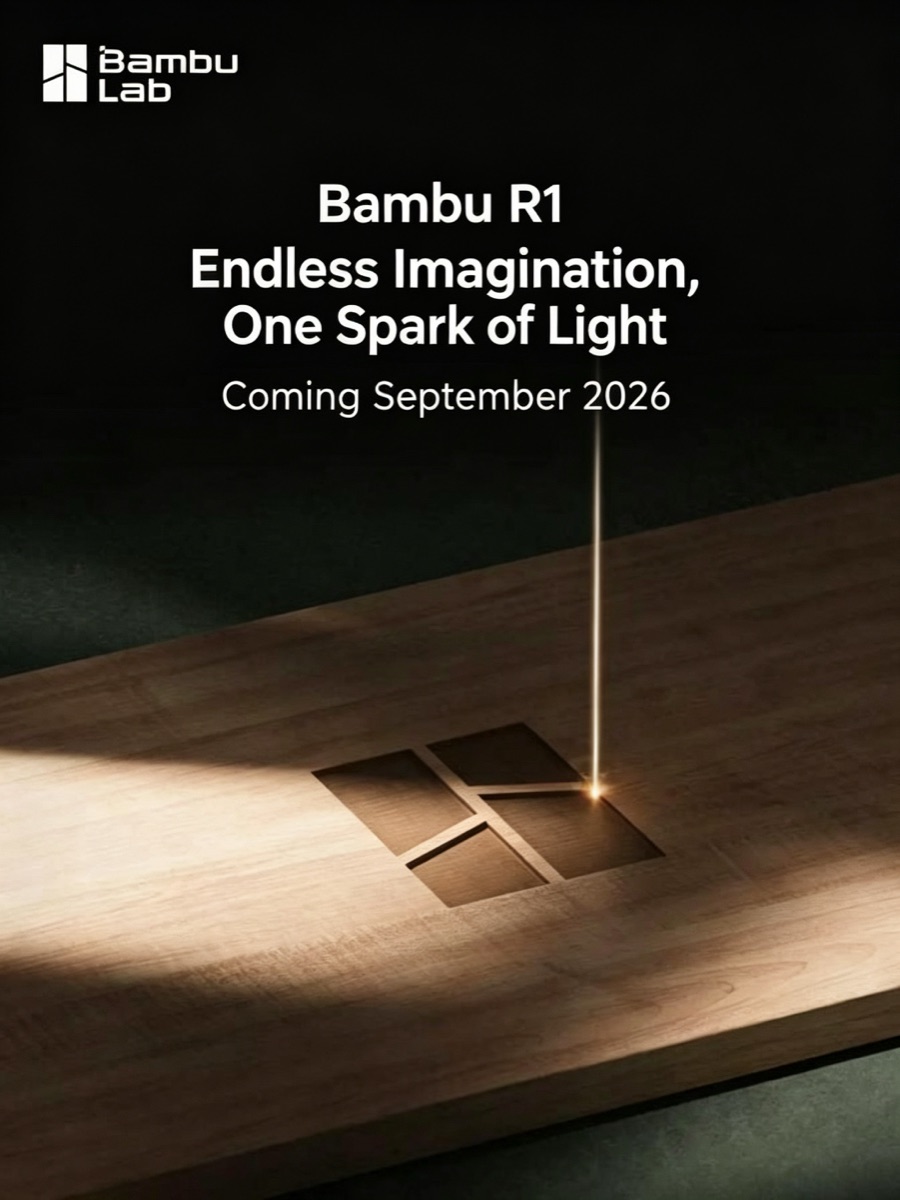
Inside the company, engineers have been working through CO2, blue-light, and fiber-laser routes. The R1 is aimed squarely at consumers on price — straight at xTool's core territory — with the tagline "Endless imagination, one spark of light." The H2D already offered 10W and 40W laser modules as a dry run; the R1 upgrades laser work from an add-on feature into a standalone product line.
3D Scanning: The Pragmatic Route, Through a Partnership
In scanning, Bambu chose to lean on a specialist rather than start from zero. Its January 2026 framework deal with STAR Market-listed Scantech has the two companies co-designing a consumer scanner that Scantech manufactures and supplies. Scantech brings years of industrial experience in aerospace and automotive scanning; Bambu gets a consumer product to market quickly. The bigger prize is the closed loop: a scanner and a printer together let users digitize a real object and reprint it without ever leaving Bambu's ecosystem.
The Personal-Manufacturing Puzzle
Step back and the plan is plain. Bambu doesn't want to be known as a 3D printer company — it wants to be the hardware platform for personal manufacturing, with printers, lasers, UV machines, and scanners today and possibly desktop CNC down the road.
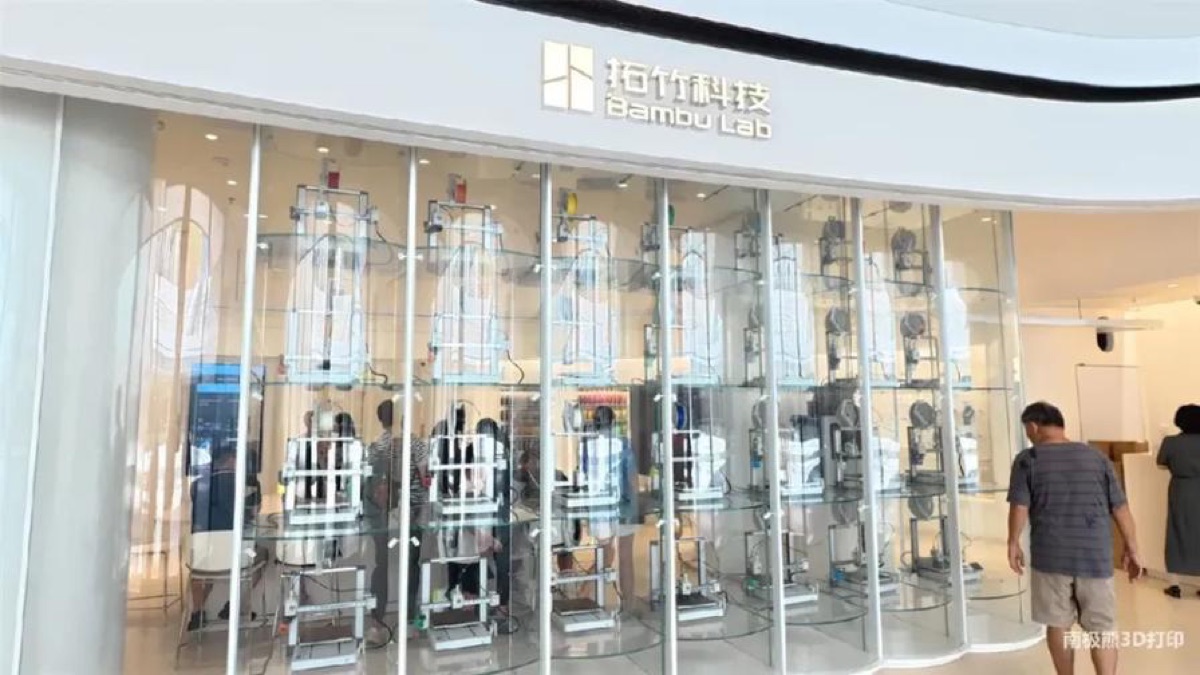
Its retail build-out points the same way. Bambu now runs flagship stores in Shenzhen, Shanghai, Chengdu, Guangzhou, Chongqing, Nanjing, and Hangzhou, and its gear is stocked in more than 60 Apple-authorized stores and 64 Sam's Club locations. These aren't just billboards. They're the place where ordinary shoppers actually see and touch tools most have never used.
The Takeaway
Bambu isn't even six years old. Behind this push sit billions of RMB in cash, an R&D organization of more than 1,000 people, and a user base millions of machines deep. Until now, 3D printing, laser work, UV printing, and scanning were separate categories — different brands, different software, different materials to manage. Bambu is trying to fold them into one brand, one ecosystem, one user experience.
The headwinds are real. UV printing drags in printhead drives, ink-path systems, and material chemistry that have little to do with FDM printing. xTool already holds strong ground in consumer laser. And running several product lines at once is a genuine test of management. Even so, the direction is clear: personal manufacturing is moving from a scattered bag of tools toward an integrated platform — and Bambu intends to be the company that defines it.
Source: Nanjixiong 3D Printing Network, via Tencent News (August 21, 2026).