HT-PLA Selection Guide for Desktop FDM: When It Holds, When It Fails, and How to Decide
Sep 3, 202615 min readMaterial Guide
HT-PLA is not a wonder material. It is standard PLA with a crystallization package that lets an annealed part survive temperatures where ordinary PLA turns rubbery. That single change opens a useful band of applications between "PLA is fine" and "switch to PETG/ABS." It also creates a specific failure mode: a part that is perfectly rigid at the desk will sag above its glass transition unless it has been annealed, and even an annealed part has a load-dependent ceiling. This guide gives the numbers, the application map, and a go/no-go checklist.
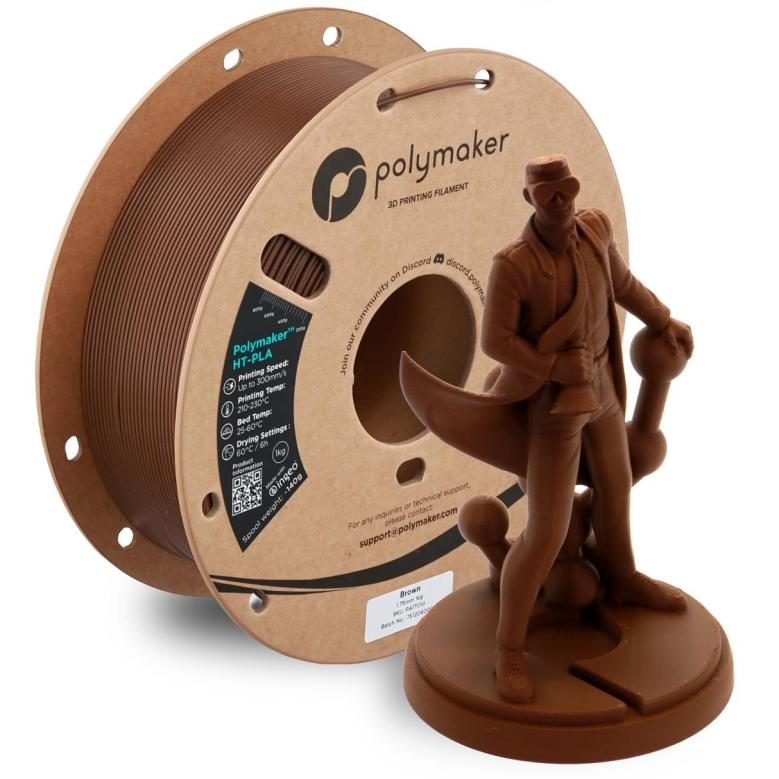
Polymaker HT-PLA filament (brown) with a printed sample. The spool label lists the print window (210–230 °C nozzle, 25–60 °C bed) and drying settings — the grade this guide uses as its primary data anchor.
1. Material Properties: HT-PLA vs. Standard PLA
The table below is built primarily from Polymaker HT-PLA TDS data (the most complete public sheet in 2026) and cross-checked against Bambu Lab filament guides and peer-reviewed annealing studies. Treat every cell as a typical band, not a guarantee. HDT shifts with load (0.45 vs. 1.8 MPa), infill, print orientation, and annealing schedule; impact numbers are Charpy notched and notoriously grade-sensitive.
Property
Standard PLA (as printed)
HT-PLA (as printed)
HT-PLA (annealed)
What it means for a part
HDT @ 0.45 MPa
55–60 °C
61 °C
100–115 °C
The headline number. Only the annealed column is the "high-temp" one.
HDT @ 1.8 MPa
~55 °C
~58–60 °C
~80–85 °C
Under real bearing load, the ceiling drops 25–30 °C. Do not design to the 0.45 number.
Vicat softening
60–63 °C
145–156 °C
148–155 °C
Explains the "150 °C no-sag" marketing claim: no load, short exposure only.
Glass transition (Tg)
58–62 °C
~60 °C
~60 °C
Above ~60 °C the amorphous phase softens regardless of annealing; crystallinity carries the load.
Tensile strength (XY)
50–60 MPa
~43 MPa
~43 MPa
HT-PLA is not stronger than PLA; it is more heat-stable.
Young's modulus (rigidity)
3.0–3.5 GPa
~3.4–3.8 GPa
Slightly higher
Stiff, good for brackets and housings. Not a flexible material.
Charpy notched impact
2–4 kJ/m²
~4.9 kJ/m²
~4.7 kJ/m²
Still brittle. Annealing trades a little toughness for heat.
Elongation at break
5–10%
~3–5%
~2.3%
It will snap before it bends. Not for drop loads.
Creep resistance
Poor above 45 °C
Marginal above Tg
Improved up to ~80–90 °C under low load
Time under load at temperature matters as much as peak temperature.
Moisture uptake (24 h)
~0.1–0.3%
~0.1–0.3%
Same
Low vs. nylon/PETG. Dry if stored open >2–3 weeks; wet spool = popping and weak layers.
Two reading rules: First, the as-printed HT-PLA column is barely better than standard PLA on heat — the marketing heat numbers all assume annealing. Second, the 150 °C figure is a Vicat/no-load softening point, not a working temperature. A part under even light bearing load should be capped near the 1.8 MPa HDT, roughly 80–85 °C after annealing.
2. Where HT-PLA Actually Fits
The common thread across every category below: the part sees elevated temperature but low to moderate static load, stays dry, and does not take impacts. If those three hold, HT-PLA (annealed) usually beats PETG on stiffness and printability and beats ABS on odor and ease.
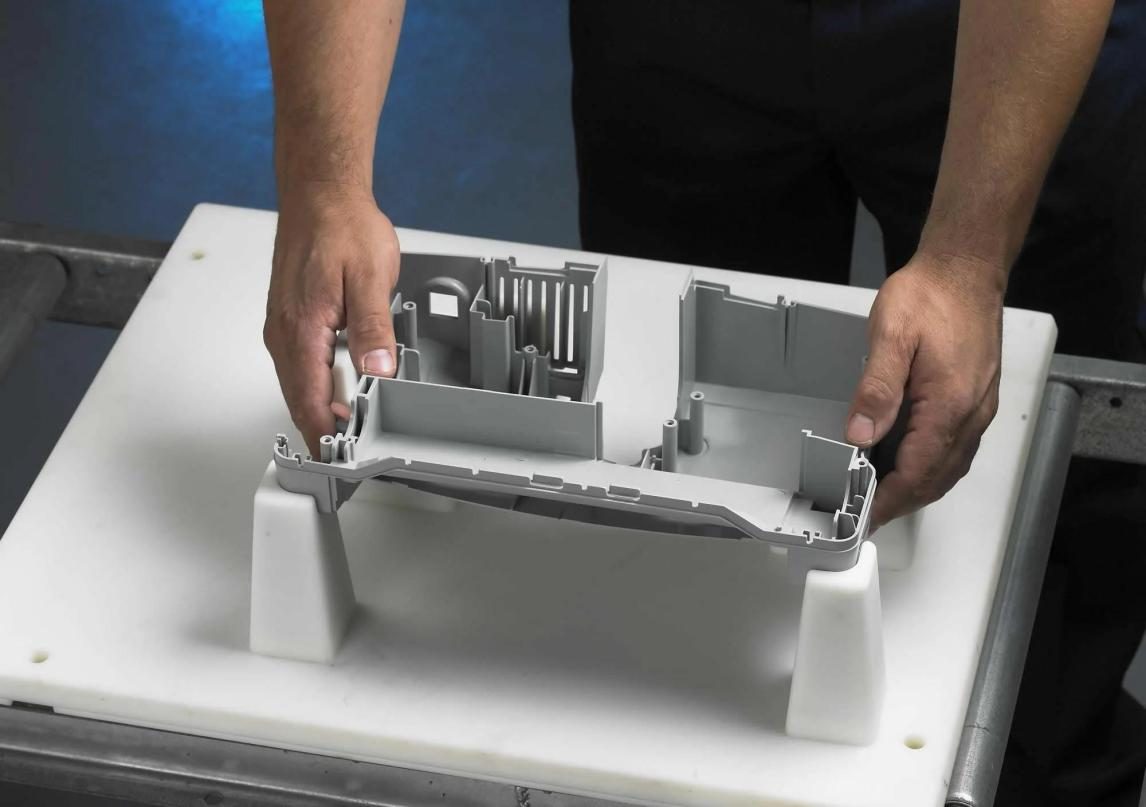
A large FDM-printed assembly fixture in use on the shop floor. Jigs, alignment nests, and low-cycle tooling are the strongest fit for annealed HT-PLA: static load, room-to-warm ambient, and a dry environment.
2.1 Kitchen and dining items (dry, warm, non-cooking)
Product
Why HT-PLA
Performance anchor
Coffee pod holders / mug racks / cup dispensers
Sits near a warm machine; no direct heat; static load only.
Annealed HDT 0.45 ~107 °C handles 60–80 °C ambient with margin.
Cutlery trays, utensil organizers, spice racks
Warm kitchen air, no dishwasher cycle, low load.
Rigidity (3.4 GPa) keeps drawers from flexing; low moisture uptake.
Cookie / pastry cutters (cold use only)
Room-temp dough, hand pressure, easy to print custom shapes.
Stiffness and detail; hand-wash only. Not for warm dough >50 °C.
Planters and plant pots (with drainage)
Outdoor sun raises black plastic above 60 °C; static soil load.
Annealed part survives greenhouse heat; coat or line if you want longevity (PLA hydrolyzes in constant wet soil).
Napkin holders, trivet bases (not the hot-contact face)
Warm but below 80 °C; decorative.
Use as a structural base; put cork or silicone on the hot face.
2.2 Automotive interior parts
Product
Why HT-PLA
Performance anchor
Dashboard mounts / phone holders / clip-in trim
Cabin soak can hit 70–85 °C in summer sun; static load.
Annealed HDT 1.8 ~80–85 °C is the real limit — design to it, add ribs, avoid black in direct sun (black runs 10–15 °C hotter).
Vent clips and air-vent accessories
Moderate heat, low load, easy to prototype custom fits.
Printability and stiffness; PETG is the usual alternative, HT-PLA is stiffer.
Center-console organizers / tray dividers
Warm cabin, no direct sun load, static.
Low creep at cabin temps once annealed.
Under-dash cable brackets / fuse covers
Ambient <60 °C, low load, hidden from UV.
Easy printing; acceptable without annealing if never sees sun.
Custom switch housings / gauge pods
Warm, dry, static; needs dimensional accuracy for fit.
Anneal first, then fit; expect 0.5–2% shrink.
2.3 Electronics enclosures and brackets
Product
Why HT-PLA
Performance anchor
Raspberry Pi / Arduino enclosures with passive heat
Internal air 40–60 °C; static; no venting needed at low power.
As-printed HT-PLA is enough below 60 °C; anneal for enclosed hot boxes.
Power supply covers / LED driver housings (low wattage)
Each entry below names the failure mode and the condition that triggers it. If your part matches the trigger, pick another material — annealing will not save it.
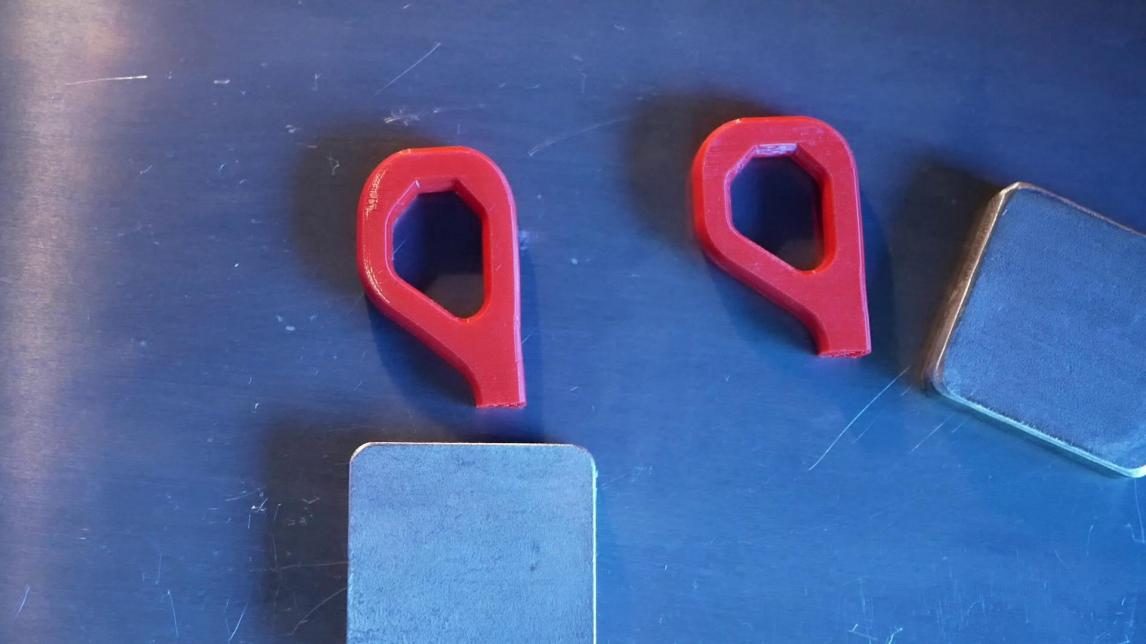
Heat-and-load test of printed hooks at 170 °C: the as-printed hook (left) has deformed; the annealed hook (right) holds its shape. This is why as-printed HT-PLA is ruled out of any high-temperature load-bearing use — annealing is not optional for the advertised heat numbers.
Application
Failure mode
Trigger condition
Better material
Long-term high-temp load-bearing (engine bay, near heaters, hot-air ducts under load)
Creep and sag; crystallinity relaxes under sustained load above ~80 °C.
Sustained >80 °C at any meaningful bearing stress, or >100 °C even low load.
ABS, ASA, PETG (up to ~75–80 °C), PC, or PA-CF for real heat.
High-impact / drop / snap-fit parts (phone cases, tool handles, drone arms, clips that flex)
Any impact, point load, or repeated flex >a few cycles.
PETG, ABS, ASA, TPU for flex; PLA+ for a modest toughness bump.
Long-term food contact, hot food, or hot steam (espresso parts, kettle handles, steam wands, baby bottle parts)
Heat distortion plus hydrolysis; additives/colorants may not be food-grade; PLA softens in hot/steam.
Contact with food/liquid >50 °C, steam, or repeated hot washing.
PETG (food-grade grades), PP, silicone, or stainless; confirm the specific grade's food-contact compliance.
Dishwasher-safe items
Heat (55–70 °C wash, >70 °C dry) + moisture + detergent cause warping, whitening, hydrolysis, and layer separation.
Any dishwasher cycle, even "low temp."
PETG (top rack only, some grades), PP, ASA; or hand-wash the HT-PLA part.
Microwaveable items
Rapid local heating above Tg; PLA contains no microwave-safe rating; additives can arc or melt.
Any microwave use, even "reheat only."
PP, silicone, microwave-safe PET; never HT-PLA.
Constant-water / submerged parts (fountains, aquariums, irrigation, boat fittings)
Hydrolysis: PLA slowly breaks down in warm water, losing strength over weeks-months.
Continuous immersion, especially >30 °C water.
PETG, ASA, PP, PA; PLA is acceptable for short cold-water use only.
UV-exposed outdoor structural parts (sun-facing brackets, exterior trim)
UV chain scission → embrittlement and chalky surface in weeks-months; black parts heat-soak above Tg.
Direct sun, structural load, expected life >3–6 months.
ASA (best), ABS, PETG with UV stabilizer; add a top coat if you must use HT-PLA.
Bearing / bushing surfaces under load or speed
Wear and galling; PLA has no lubricity and softens from friction heat.
Any sliding surface with load or repeated motion.
PETG + PTFE grease, PA, POM/Acetal, or insert a real bearing.
4. Process Limits: Annealing Is the Whole Game
Annealing is mandatory if you want the advertised heat resistance. As-printed HT-PLA has an HDT around 61 °C — essentially ordinary PLA. The crystallization that pushes HDT to 100+ °C happens in the oven, not the printer. A part sold as "HT-PLA" but never annealed will fail at the same temperature as normal PLA.
Parameter
Typical range
Notes
Annealing temperature
80–110 °C; Polymaker specifies 80–100 °C (100 °C recommended); Bambu HT grades list 85–100 °C; Protopasta/NatureWorks grades go up to 110–120 °C.
Use the grade's own TDS. Going above the grade's window causes sagging and distortion during the soak.
Hold time
30 min (Polymaker) to 6–12 h (Bambu recommendation for PLA family); academic studies use 30 min–2 h at 90–100 °C.
Thick walls (>4 mm) need longer soak to crystallize through. Thin parts can over-anneal and warp fast.
Method
Convection oven or temperature-controlled chamber; support the part on sand, salt, or a flat fixture; light clamping/weights allowed; cool slowly inside the turned-off oven (2–4 h).
Never a microwave, never a kitchen toaster oven with hot spots, never open-air on a hot plate. Uneven heat = warped part.
Linear shrinkage
~0.5–2% typical; older anneal-grade PLAs up to 2–5%; Polymaker HT-PLA is formulated for low shrink.
Print slightly oversized or leave machining stock for fit-critical parts. Do not anneal after final assembly — anneal before.
Surface appearance
Matte-to-slightly-rough; possible whitening/cloudiness from crystallinity, especially in natural/translucent colors; layer lines may become more visible; glossy colors lose gloss.
Paint or vapor-smooth? PLA does not vapor-smooth cleanly. Sand and prime if cosmetics matter. Dark/opaque colors hide crystallinity whitening best.
Wall and structure rules
Keep walls 1.2–3 mm for predictable annealing; >5 mm thick sections risk internal voids and uneven crystallization; avoid large flat unsupported panels (they dish); add ribs on the back instead of thick sections; 100% infill or near it for heat-critical parts.
Hollow thin shells will not reach the datasheet HDT. Design for the annealed state, not the as-printed state.
Print orientation
XY properties are the datasheet values; Z-axis (layer) strength and HDT are lower — load across layers is the weak direction.
Put the bearing surface in XY; orient critical features so load does not peel layers.
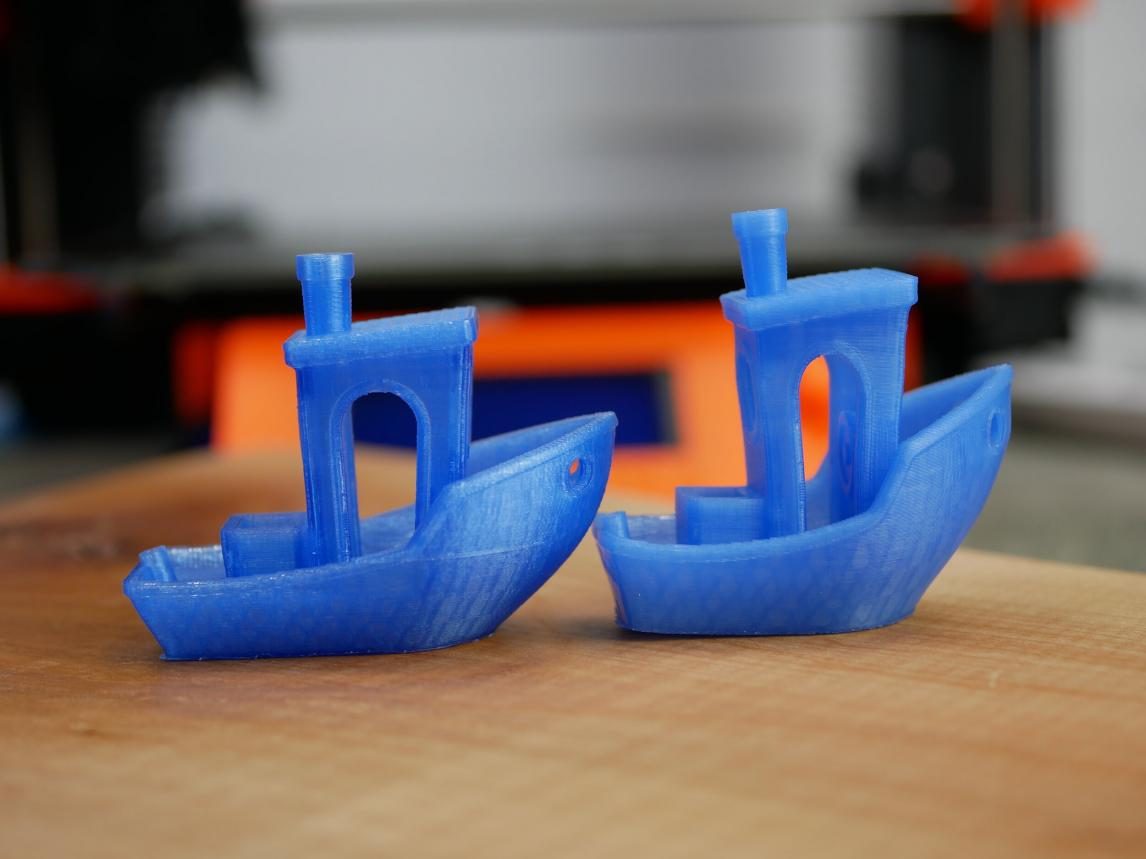
PLA benchy before (left) and after (right) oven annealing. The annealed part is visibly smaller and has lost fine edge detail — the 0.5–2% linear shrink and surface change are not theoretical.
Practical rule: print the part rough-sized, anneal it, then finish-fit. If a feature needs a tight bore or a snap fit, leave 0.2–0.4 mm stock and ream/file after annealing. Trying to anneal a press-fit part is how you end up with a part that no longer fits.
5. Material Trade-off: HT-PLA vs. PETG, ABS, ASA
The choice is rarely HT-PLA vs. nothing. It is HT-PLA vs. the next material up. The table uses Polymaker-family values where available; treat as relative ranking.
Criterion
HT-PLA (annealed)
PETG
ABS
ASA
Heat (HDT 0.45 / 1.8 MPa)
107 / ~80–85 °C
78 / 75 °C
100 / 98 °C
~95–100 / ~90 °C
Tensile strength
~43–50 MPa
~50 MPa
~33 MPa
~35–45 MPa
Rigidity (modulus)
3.4–3.8 GPa (stiffest)
2.1 GPa
2.2 GPa
~2.0–2.5 GPa
Toughness / impact
Brittle (4.7 kJ/m², 2.3% elong.)
Tough in practice (low notched score, high elongation)
Tough (18 kJ/m²)
Tough, similar to ABS
Weather / UV resistance
Poor (months outdoors)
Fair (yellows / embrittles over time)
Fair-poor (yellows)
Excellent (outdoor-grade)
Moisture / chemical
Low uptake; hydrolyzes in hot water
Moderate uptake; good chemical resistance
Low uptake; good chemical resistance
Low uptake; excellent chemical/UV
Print difficulty
Easy (PLA-like, 200–230 °C, no enclosure)
Moderate (stringing, 230–260 °C, dry filament)
Harder (warp, fumes, 245–265 °C, enclosure recommended)
Harder (warp, fumes, enclosure; similar to ABS)
Post-processing
Easy to sand and paint; glue with CA; no easy vapor smooth
Sands okay; glues with CA/MEK; can vapor-smooth with EA
Natural PLA can be food-grade; HT additives/colors need verification
Food-grade grades available
Generally not food-contact
Generally not food-contact
Cost (1 kg, 2026)
$19–30 (Polymaker HT-PLA ~$19–25)
$20–30
$20–30
$25–40
Decision rules from the table: pick HT-PLA when you need stiffness + easy printing + intermittent heat up to ~80 °C under load and the part stays dry and indoors. Pick PETG when toughness, chemical resistance, or moderate heat without annealing matters more than stiffness. Pick ABS when you need a smooth, tough, heat-resistant part and can run an enclosure with fume extraction. Pick ASA when the part lives outside — full stop, HT-PLA is the wrong material for outdoor structural work. If the part must survive >90 °C under load, none of these four is enough; move to PC, PA-CF, or PPS.
6. Go / No-Go Selection Standard
Use the threshold table first, then the checklist. If any threshold is exceeded, the answer is no unless you redesign around it.
Dimension
HT-PLA (annealed) safe limit
If exceeded
Continuous service temp (low load, <0.45 MPa)
≤ 90 °C; short excursions to 100 °C
Switch to ABS/ASA/PC
Continuous service temp (bearing load, ~1.8 MPa)
≤ 75–80 °C
Switch to ABS/ASA/PC/PA-CF
Peak temp, no load, short exposure
≤ ~120 °C (Vicat ~150 is not a working temp)
Redesign or switch material
Load type
Static or quasi-static only
Impact/fatigue → PETG/ABS/ASA/TPU
Contact medium — dry air
OK
—
Contact medium — occasional water, cold, hand-washed
OK with drying
—
Contact medium — continuous water / hot water / steam
Not OK (hydrolysis)
PETG/PP/PA/ASA
Contact medium — food/liquid >50 °C, dishwasher, microwave
Not OK
Food-grade PETG/PP/silicone/metal
UV / outdoor structural, >3 months
Not OK
ASA (or PETG + coating for short duty)
Sliding / bearing surface
Not OK under load
POM/PA/insert bearing
Dimensional tolerance after anneal
Plan 0.5–2% shrink; leave stock
Tighter → print oversized, finish after anneal
Yes / No checklist (answer for your specific part):
Will the part ever exceed 80 °C while carrying a load? YES → not HT-PLA. NO → continue.
Will it see impact, dropping, or repeated flexing? YES → not HT-PLA (use PETG/ABS/ASA/TPU). NO → continue.
Will it be in continuous water, steam, dishwasher, or microwave? YES → not HT-PLA. NO → continue.
Will it live outdoors in direct sun for more than ~3 months as a structural part? YES → ASA, not HT-PLA. NO → continue.
Can you anneal it after printing (oven/chamber, 80–100 °C, 30 min+), and accept 0.5–2% shrink? YES → continue. NO → use as-printed only, which caps you at ~60 °C — reconsider PETG/ABS.
Is the load static, the environment dry and indoor, and cosmetics achievable with sanding/painting? YES → HT-PLA is a strong choice, often the best stiffness-per-ease-of-print option. NO → revisit the failed item above.
Decision flow (one paragraph): Start at the temperature: under 60 °C continuous, ordinary PLA or HT-PLA as-printed both work and HT-PLA's premium is optional. Between 60 and 80 °C under load, annealed HT-PLA is the sweet spot — stiffer and easier than PETG, no enclosure needed. Between 80 and 100 °C, annealed HT-PLA only at low load; for real load use ABS or ASA. Above 100 °C under load, go PC, PA-CF, or metal. Then layer in the environment: water/steam/dishwasher/microwave rules HT-PLA out regardless of temperature; outdoor structural rules HT-PLA out in favor of ASA; impact rules it out in favor of PETG/ABS. If you pass all of that, the last check is process: you must be willing to anneal and to design for 0.5–2% shrink. If you are not, you are buying ordinary PLA with a higher price tag.