Operator's feasibility note · US and EU maker, cost and hardware sources · September 2026
Filament got expensive in 2026. One widely cited industry read put the year's price jump at close to 59%, and anyone running a multi-material setup watched the scrap pile grow at the same time. Somewhere between 15% and 30% of a typical print leaves the bed as supports, rafts, purge blocks or straight-up failures, and PLA — sold as plant-based — still sits in a landfill for centuries because it only breaks down in a controlled 55–60°C industrial composting line.
Into that gap Creality launched the Filament Maker M1 and the Shredder R1, a desktop pair that grinds scrap, dries it, extrudes fresh 1.75 mm filament and winds it onto a spool. Its Indiegogo run, which closed in spring 2026, pulled roughly $4.9 million from more than 3,900 backers and became the biggest 3D-printing crowdfunding campaign of the year, with units shipping from Q2 2026.
The interesting question is not whether the campaign worked. It is whether the hardware is a sound buy for an actual operator. The short version: the process is genuinely feasible, the recycled filament is not equivalent to a store-bought spool, and whether the thing pays for itself depends almost entirely on how much plastic you already move.

1. What the system actually is
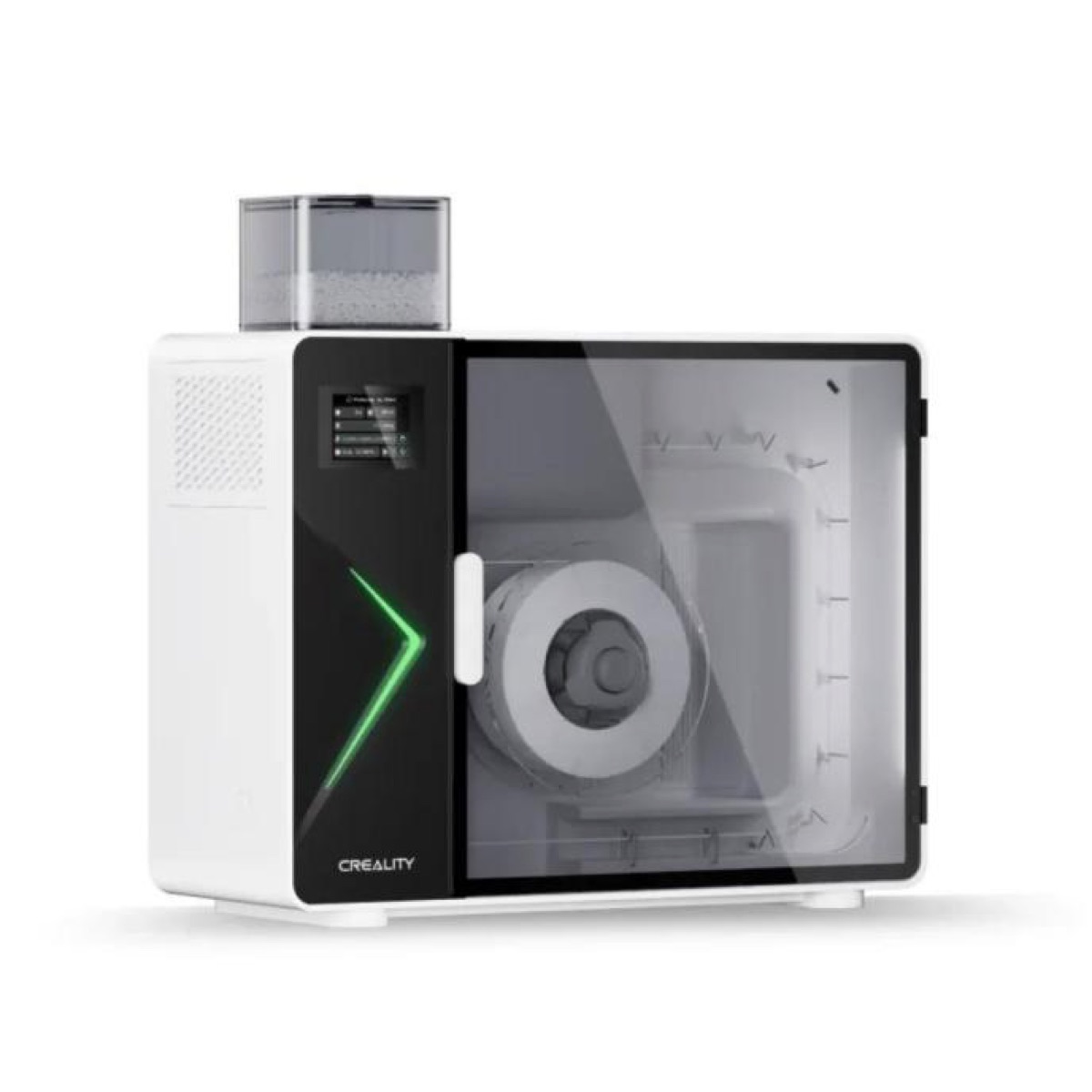
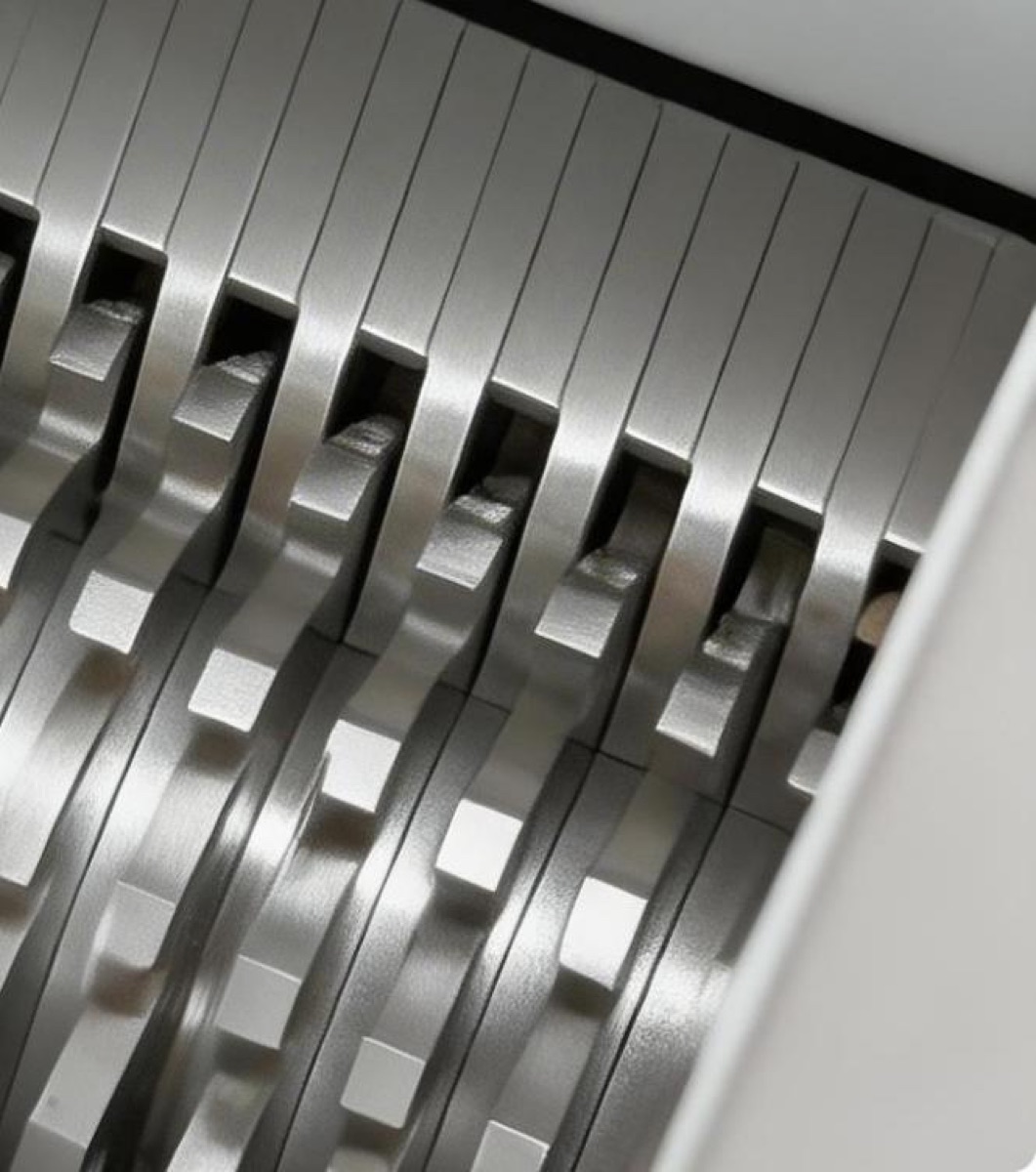
This is two separate machines that close a loop, not one magic box. The R1 is the front end. It takes rigid print waste, shreds it with dual-shaft hardened A4 steel blades driven by a 650 W, 60 Nm motor, and reduces it to particles of 4 mm or smaller at up to 3 kg per hour. A 100 W PTC heater and a small fan then dry those regrinds inside the same 13 kg enclosure, up to 70°C, so wet granules do not foam in the extruder. Lid-open cutoff, a physical emergency stop, anti-jam reverse and a full-bin sensor are built in.
The M1 is the back end: a 15 kg benchtop extruder with three independent heating zones running from 120 to 350°C, eight cooling fans, HEPA plus activated-carbon filtration, a 3.2-inch touchscreen, real-time diameter monitoring and adaptive pulling and spooling that winds the finished filament onto a reel. Peak output is about 1 kg per hour on PLA; power draw runs up to 1,600 W and averages near 800 W.
Creality supports eight material families — PLA, PETG, ABS, ASA, PA, PC, TPU and PET, plus carbon- and glass-fiber-filled grades — but single materials only. The company is explicit that mixing, say, PLA and TPU in one batch is forbidden, because mixed melt streams extrude unpredictably and can damage the machine.
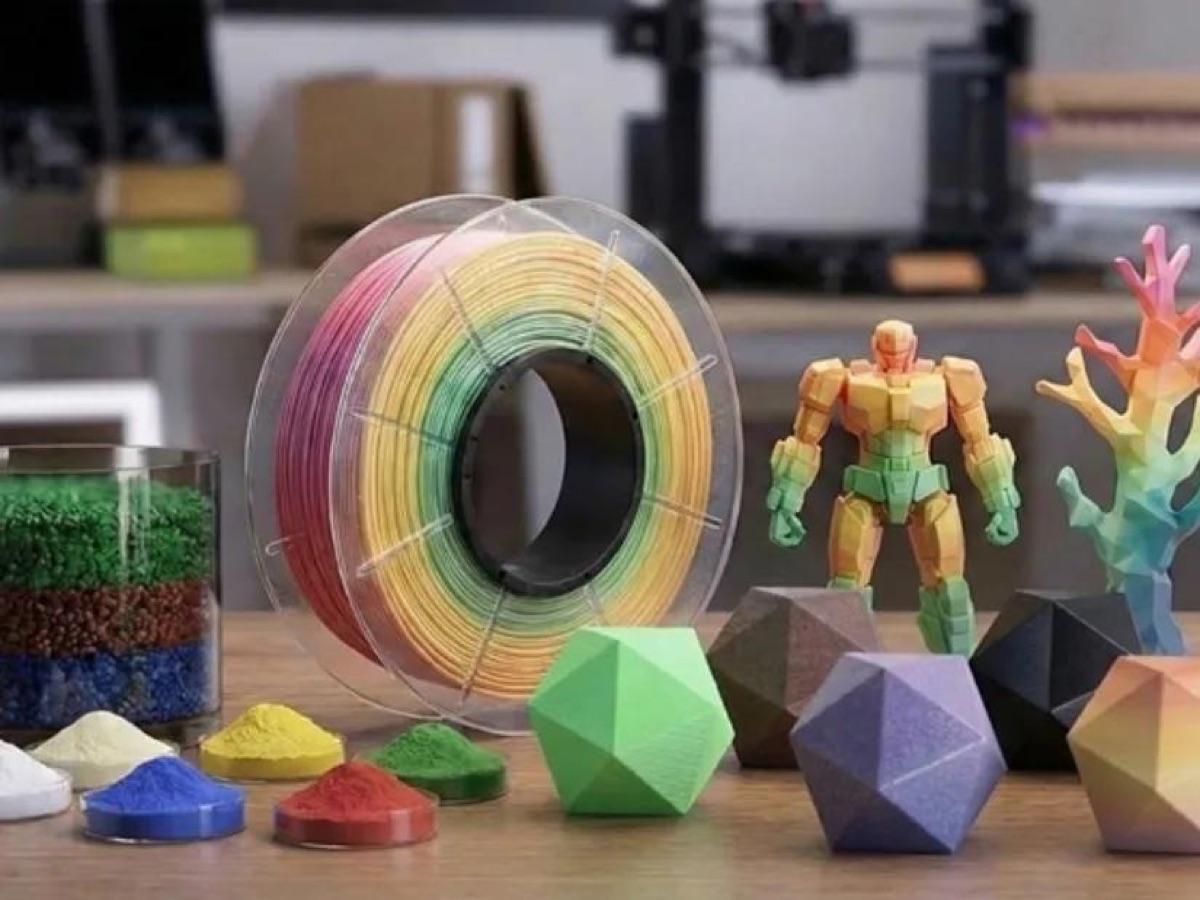
Note also that the M1 is not purely a recycler. Every official workflow starts with virgin pellets as the base, and recycling your own scrap is one input among custom colors, scented or wood-filled blends and high-performance compounds. A starter kit ships with 2 kg of PLA pellets and five 50 g packs of color masterbatch, which tells you where Creality expects most of the output to come from.
2. Technical feasibility: yes, it makes printable filament — with an asterisk
Desktop extrusion is a solved problem in principle; Filabot pioneered it on Kickstarter back in 2012. What is new here is the integration and the price. The honest technical question is dimensional consistency, because that is what determines whether a spool prints cleanly.
Creality's own numbers draw the key distinction: filament made from 100% virgin pellets holds 1.75 mm ±0.05 mm, while filament made from recycled scrap widens to ±0.1 mm (a 1.65–1.80 mm band). Good commercial filament from houses such as Bambu or eSUN holds ±0.02–0.03 mm. That gap sounds small on paper and is not small at the nozzle. Through a 0.4 mm tip, a swing from 1.65 to 1.85 mm is roughly a 5.7% change in the plastic being fed, which the printer experiences as wandering flow even after a careful calibration. Printers with tight PTFE paths or Bowden tubes can clog or under-extrude, and an AMS hub is the least forgiving environment of all — oversized filament jams it, undersized filament slips. Creality buries the same warning in its spec sheet: a higher ratio of virgin pellets improves precision and stability.
The second technical limit lives in the material itself. Every melt cycle shortens polymer chains, so recycled plastic comes back a little weaker and more brittle. PLA survives roughly three to five mechanical passes before it gets too brittle to trust, losing on the order of 5–15% of tensile strength per pass; published reprocessing work measured close to a 49% drop in molecular weight after five cycles, and color drifts toward muddy grey unless you sort by color. PETG is more forgiving at five to seven cycles; nylon needs careful drying and lasts only two to three; flexible TPU wraps around shredder blades and is barely practical on desktop machines; cured resin prints are thermoset plastic and cannot be re-melted at all.
The standard workaround is blending 30–50% virgin pellets into every recycled batch, which both restores strength and tightens diameter. Treat the output accordingly: draft prints, fit tests, jigs, fixtures, packaging inserts and non-visible functional parts are fair game; visible cosmetic surfaces, flexible parts, AMS multi-color jobs, 0.2 mm-nozzle work and anything load-bearing should stay on commercial filament.
Process discipline is what separates a clean spool from a frustrating one, and it is mostly labor rather than money. Sort waste into labeled bins by material and color and never mix them; pull out metal nozzles, inserts and magnets before shredding; dry parts before shredding and dry the granules again for four to eight hours before extruding; mark each spool with its recycling generation; run a flow calibration and save a slicer profile for every recycled reel; and run the machine in a ventilated room. None of this is difficult. All of it takes time, which is the cost the marketing edits out.
3. Economic feasibility: three different payback curves
There is no single answer to "does it pay back," because the machine has three distinct business cases and they do not look alike.
4. Where it sits in the market
Creality did not invent desktop filament making; it undercut the entry price for an integrated shred-dry-extrude-spool workflow. The 2026 field looks like this:
Against that lineup, the $899 bundle occupies a genuinely empty shelf: the cheapest all-in-one closed loop from a high-volume manufacturer people already trust. It is less precise than Filabot or 3devo and more integrated and supported than the DIY tier. That positioning, more than the recycling claim itself, explains the crowdfunding total.
5. Risks and caveats worth stating plainly
- First-generation hardware. No independent reviewer has run a production M1/R1 in a home or shop for 30 straight days. Real-world diameter consistency, noise, dust containment and wear-part replacement cost are still open questions; early buyers are effectively beta testers.
- Recycled tolerance is a claimed best case. The ±0.1 mm figure assumes controlled, sorted, single-material input. Mixed colors, contaminated purge blocks and aged scrap can perform worse, and no public long-run data exists yet.
- It is hands-on, not one-button. Sorting, double drying, manual lead-in, per-spool flow calibration and spool winding are real labor. If you want the convenience of opening a fresh store spool, this is not that.
- Power and space add up. The M1 draws up to 1,600 W and averages near 800 W while running, and the pair together weighs 28 kg and needs bench room plus ventilation.
- Do not over-read the environmental claim. Recycling your own clean, sorted, single-resin stream is real and worthwhile; it is not a substitute for reducing failed prints in the first place, and cured resin and mixed plastics cannot enter the loop.
6. Verdict: buy, wait, or skip
You run an AMS-heavy or fleet operation and genuinely generate the scrap, you print at least a couple of kilograms a month, you want to develop custom colors or blends you cannot buy, or you run a workshop, farm, classroom or studio where throughput and the educational value carry the cost. Go in planning to feed mostly virgin pellets, blend 30–50% of them into every recycled batch, and reserve recycled filament for non-critical parts.
You run a single printer with moderate waste, you need ±0.05 mm or better consistency for visible or functional product, or you simply dislike early-access hardware. The product is clearly happening after a $4.9 million campaign, so there is no scarcity to chase.
You generate under a kilogram of scrap a month, you expect recycled spools to behave exactly like Bambu house filament, or you are buying it mainly to save money on a light printing habit — at that volume the payback is measured in the better part of a decade.
Feasibility, then, is a qualified yes. As a piece of engineering, the M1 and R1 do what they claim: they put a real, if imperfect, closed loop on a desktop at a price the hobby market has never seen. As a business purchase, they are a volume tool disguised as an eco-friendly gadget. The operator who feeds it pellets, runs disciplined batches and directs recycled filament toward jigs and drafts will get real value; the operator who buys it to erase a small bin of failed prints is paying about nine years early for a feel-good story. Know which one you are before you click buy.